Continuous Evaluation (Evals) for LLMs: The New Unit Testing for AI Systems
Meta Description: Learn how LLM Evals replace traditional unit testing for non-deterministic AI. Master evals frameworks, synthetic test generation, and continuous CI/CD integration.
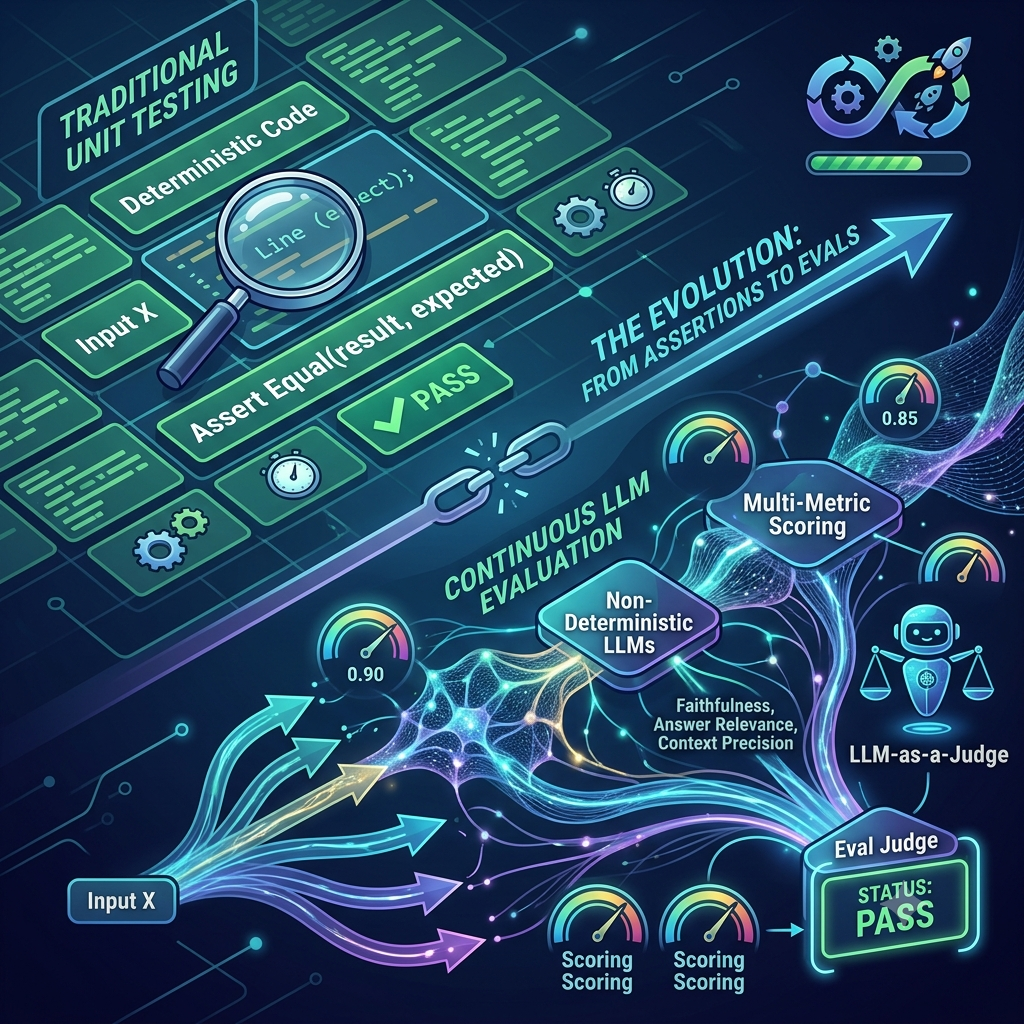
┌────────────────────────────────────────────────────────────────────────┐
│ TRADITIONAL TESTING VS. LLM EVALS │
│ │
│ TRADITIONAL UNIT TESTING CONTINUOUS LLM EVALUATION │
│ ┌──────────────────────────┐ ┌────────────────────────────┐ │
│ │ Deterministic Code │ │ Non-Deterministic LLMs │ │
│ │ Input X -> Assert Y │ │ Input X -> Distribution Y │ │
│ └────────────┬─────────────┘ └─────────────┬──────────────┘ │
│ │ │ │
│ ▼ ▼ │
│ ┌──────────────────────────┐ ┌────────────────────────────┐ │
│ │ Pass / Fail Assertions │ │ Multi-Metric Scoring │ │
│ │ Binary Execution Path │ │ (Faithfulness, Relevance) │ │
│ └──────────────────────────┘ └────────────────────────────┘ │
└────────────────────────────────────────────────────────────────────────┘
The fundamental paradigm of software engineering has shifted. For decades, software quality assurance relied on deterministic logic: given a specific input $X$, a function executing code path $P$ must consistently produce exact output $Y$. If assert_equal(result, expected) evaluated to true, the test passed.
Large Language Models (LLMs) break this paradigm. LLMs operate as probabilistic state engines. The same system prompt and user input can yield variations in structure, tone, phrasing, and reasoning across runs. Traditional assertions fail when applied to generative outputs.
This non-determinism presents a major hurdle for enterprise AI deployments. How do engineering teams update system prompts, swap underlying models, or adjust Retrieval-Augmented Generation (RAG) vector indexes without introducing regressions or hallucinations?
The solution is Continuous LLM Evaluation (Evals)—the modern quality assurance framework designed specifically for non-deterministic AI systems.
💡 Key Takeaways
- Probabilistic Testing: LLM Evals replace binary pass/fail unit assertions with multi-dimensional statistical scoring frameworks.
- The Triad of RAG Quality: Production RAG applications require continuous measurement across Faithfulness, Answer Relevance, and Context Precision.
- LLM-as-a-Judge: Leveraging powerful baseline models to evaluate candidate outputs enables automated, highly scalable regression testing.
- CI/CD Integration: Automated eval gates in deployment pipelines prevent model drift, unexpected prompt regressions, and security vulnerability leaks.
The Crisis of Non-Determinism in AI Software Testing
When teams deploy AI agents and RAG applications to production, they encounter three core testing challenges:
THE THREE FACES OF LLM DRIFT
│
┌──────────────────────────────┼──────────────────────────────┐
▼ ▼ ▼
┌────────────────────────┐ ┌────────────────────────┐ ┌────────────────────────┐
│ Silent Regression │ │ Hallucination Drift │ │ Prompt Sensitivity │
│ Updating system prompt │ │ Fine-tuning improves A │ │ Small wording tweaks │
│ fixes Case A, breaks B │ │ but hallucinates on C │ │ cause schema failures │
└────────────────────────┘ └────────────────────────┘ └────────────────────────┘
Without an automated evaluation layer, development teams end up relying on manual spot-checking—a process that is slow, subjective, and hard to scale across updates.
The RAG Evaluation Triad
When evaluating Retrieval-Augmented Generation architectures, testing the final text output alone is insufficient. Engineers must evaluate both the Retrieval Step (finding the right context) and the Generation Step (synthesizing the answer correctly).
┌────────────────────────────────────────────────────────────────────────┐
│ THE RAG EVALUATION TRIAD │
│ │
│ ┌──────────────────────────┐ │
│ │ User Query / Prompt │ │
│ └─────────────┬────────────┘ │
│ │ │
│ Context Precision │ Answer Relevance │
│ (Retrieval Quality) │ (Response Quality) │
│ ▼ │
│ ┌──────────────────┐ Faithfulness ┌────────────────────┐ │
│ │ Retrieved Context├───────────────>│ Generated Response │ │
│ └──────────────────┘ └────────────────────┘ │
└────────────────────────────────────────────────────────────────────────┘
1. Context Precision & Recall (Retrieval Layer)
- What it measures: Did the vector search engine retrieve relevant documentation fragments, and was irrelevant noise filtered out?
- Why it matters: Irrelevant context clutters the LLM window, increases operational token costs, and leads to incorrect answers.
2. Faithfulness (Groundedness Layer)
- What it measures: Is every claim in the generated answer directly backed up by the retrieved context?
- Why it matters: High faithfulness confirms the model is relying strictly on provided enterprise documents rather than unverified internal training data.
3. Answer Relevance (Generation Layer)
- What it measures: Does the response address the original query cleanly without introducing tangential information?
- Why it matters: Ensures responses remain concise, useful, and aligned with user intent.
Hands-On Implementation: Building an Automated Eval Pipeline in Python
Let me show you how to build a production-grade evaluation pipeline using Python. We will implement an LLM-as-a-Judge pattern to score Faithfulness and Answer Relevance automatically.
Automated Evaluation Framework (eval_pipeline.py)
Python
import json
from typing import Dict, Any
from dataclasses import dataclass
from openai import OpenAI
@dataclass
class EvalResult:
faithfulness_score: float
relevance_score: float
reasoning: str
passed: bool
class LLMEvaluator:
“””Automated evaluation engine using an LLM-as-a-Judge architecture.”””
def __init__(self, judge_model: str = “gpt-4o”):
self.client = OpenAI()
self.judge_model = judge_model
def evaluate_rag_response(
self, query: str, context: str, response: str, threshold: float = 0.8
) -> EvalResult:
“””Evaluates RAG performance across Faithfulness and Answer Relevance metrics.”””
eval_prompt = f”””
You are an expert AI QA Auditor. Evaluate the following RAG system output.
[USER QUERY]: {query}
[RETRIEVED CONTEXT]: {context}
[GENERATED RESPONSE]: {response}
Evaluate the response using these two metrics:
1. Faithfulness (0.0 – 1.0): Is every statement in the response directly supported by the retrieved context?
2. Relevance (0.0 – 1.0): Does the response directly address the user query without adding unnecessary info?
Respond STRICTLY in JSON format with this exact structure:
{{
“faithfulness_score”: <float>,
“relevance_score”: <float>,
“reasoning”: “<concise step-by-step justification>”
}}
“””
raw_judge_response = self.client.chat.completions.create(
model=self.judge_model,
messages=[{“role”: “system”, “content”: “You are a precise, unbiased evaluation system.”},
{“role”: “user”, “content”: eval_prompt}],
temperature=0.0, # Zero temperature for deterministic scoring
response_format={“type”: “json_object”}
)
payload = json.loads(raw_judge_response.choices[0].message.content)
faithfulness = float(payload.get(“faithfulness_score”, 0.0))
relevance = float(payload.get(“relevance_score”, 0.0))
reasoning = payload.get(“reasoning”, “No reasoning provided.”)
# Calculate aggregate pass boundary
mean_score = (faithfulness + relevance) / 2.0
passed = mean_score >= threshold
return EvalResult(
faithfulness_score=faithfulness,
relevance_score=relevance,
reasoning=reasoning,
passed=passed
)
if __name__ == “__main__”:
print(“[INIT] Starting LLM Automated Quality Gate…”)
evaluator = LLMEvaluator()
# Test Case: System hallucinated details missing from context
sample_query = “What is the warranty coverage for the Model-X Drone?”
sample_context = “Model-X includes a 12-month standard limited warranty covering motor defects.”
sample_response = “The Model-X Drone includes a 12-month limited warranty covering motor defects and free accidental water damage replacement.”
result = evaluator.evaluate_rag_response(
query=sample_query,
context=sample_context,
response=sample_response
)
print(f”\n— EVALUATION REPORT —“)
print(f”Faithfulness Score : {result.faithfulness_score} / 1.0″)
print(f”Relevance Score : {result.relevance_score} / 1.0″)
print(f”Status Check : {‘PASS’ if result.passed else ‘FAIL’}”)
print(f”Judge Analysis : {result.reasoning}”)
Execution Output Analysis
When run against the hallucinated sample response above, the judge flags the added claim:
Plaintext
— EVALUATION REPORT —
Faithfulness Score : 0.5 / 1.0
Relevance Score : 1.0 / 1.0
Status Check : FAIL
Judge Analysis : The response correctly identifies the 12-month warranty, but hallucinates ‘free accidental water damage replacement’, which is not present in the context.
Top Open-Source LLM Evaluation Frameworks
Rather than writing custom scoring logic for every edge case, teams leverage open-source evaluation frameworks:
| Evaluation Tool | Core Focus Area | Best For |
| Ragas | Deep RAG Component Scoring | End-to-end vector search and context verification |
| DeepEval | PyTest-Integrated Testing | Continuous Integration (CI/CD) automated gates |
| Promptfoo | Matrix Testing & Red Teaming | Prompt tweaking, security testing, and latency checks |
| TruLens | Observability & Triad Tracing | Production monitoring and tracing user calls |
Integrating Evals into CI/CD Pipelines
To maintain high output quality, evaluation suites should run automatically as part of your deployment workflow:
┌────────────────────────────────────────────────────────────────────────┐
│ CONTINUOUS EVALUATION PIPELINE │
│ │
│ ┌───────────────────┐ ┌───────────────────┐ │
│ │ Git Pull Request │───────>│ Synthetic Test │ │
│ │ Prompt / Code Edit│ │ Dataset Execution │ │
│ └───────────────────┘ └─────────┬─────────┘ │
│ │ │
│ ▼ │
│ ┌───────────────────┐ ┌───────────────────┐ │
│ │ PR Merge Blocked │<───────│ Assert Score Gate │ │
│ │ (Score Drop > 2%) │ FAIL │ (Threshold >= 0.85)│ │
│ └───────────────────┘ └─────────┬─────────┘ │
│ │ PASS │
│ ▼ │
│ ┌───────────────────┐ │
│ │ Production Deploy │ │
│ └───────────────────┘ │
└────────────────────────────────────────────────────────────────────────┘
- Synthetic Dataset Generation: Use powerful base models to create hundreds of diverse query-context-answer test pairs from raw documentation.
- Regression Assertions: Set quality baselines (e.g., Average Faithfulness $\ge 0.90$). If a prompt adjustment causes scores to drop by more than 2%, block the GitHub Pull Request automatically.
- Shadow Deployments: Route real user queries to both the existing production setup and the updated candidate pipeline in parallel, comparing real-world evaluation metrics before full rollout.
Frequently Asked Questions (FAQ)
Isn’t using an “LLM-as-a-Judge” too expensive for production testing?
Evaluating every single request in production can get pricey. The common industry solution is a two-tiered testing model: run comprehensive evaluation suites during CI/CD build phases using synthetic test datasets, then sample 1% to 5% of real user traffic in production to monitor performance trends cost-effectively.
How do you prevent judge models from biasing their own outputs?
Judge bias can be mitigated by using deterministic model settings (temperature=0.0), swapping output choices in AB evaluations, enforcing strict structured JSON output schemas, and periodically auditing judge outputs against human-annotated reference datasets.
What is the difference between Deterministic Evals and Model-Based Evals?
Deterministic evals check concrete, programmatic rules like exact string matches, valid JSON structure parsing, character counts, and latency thresholds. Model-based evals assess qualitative properties like tone consistency, helpfulness, groundedness, and overall hallucination risk.
Conclusion & Action Steps
As non-deterministic AI models become core infrastructure, quality engineering must adapt. Implementing continuous evaluation frameworks gives software teams the confidence to iterate quickly on prompt structures, update underlying model versions, and scale complex AI architectures safely.
Your Next Steps:
- Install an evaluation framework using pip install deepeval or pip install ragas.
- Extract 50 representative user queries and contexts from your production environment into a golden test dataset.
- Add a basic evaluation check to your GitHub Actions or GitLab CI pipeline to catch hallucinations before they reach production.