Prompt Engineering Is Dead. Long Live Context Engineering.
- SEO Title: Prompt Engineering vs Context Engineering: What Developers Must Know
- Meta Description: Discover why prompt engineering is evolving into context engineering and how to build automated context pipelines for AI agents.
- Target Audience: AI Practitioners, Software Engineers, Tech Educators.
- Primary Focus: The shift from natural language prompt tweaking to programmatic context pipeline design.
Introduction: The Limits of Prompt Tweaking
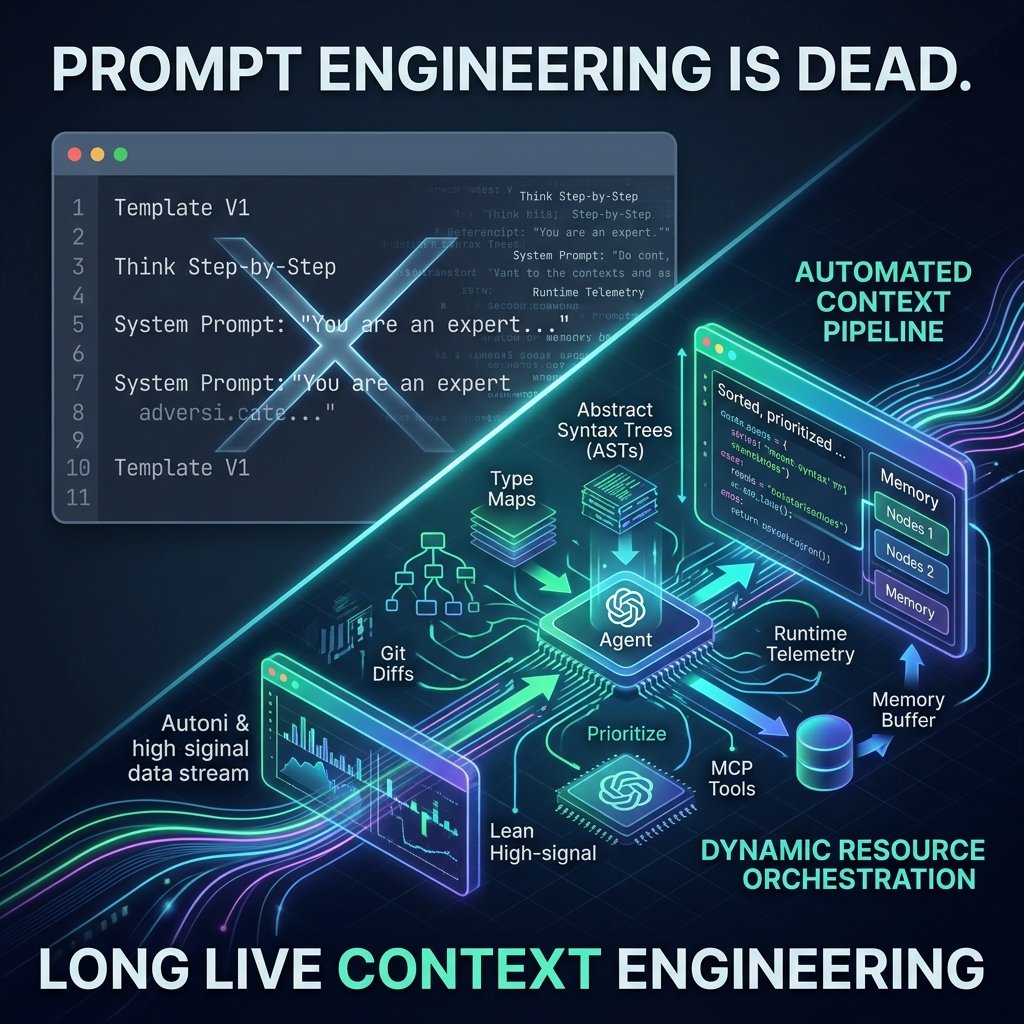
In the early stages of Generative AI, developer discourse centered around “prompt engineering”—the art of carefully phrasing system prompts, tweaking adjectives, and adding magic phrases like “think step-by-step” to guide Large Language Models (LLMs). While effective for isolated text generation, this manual approach breaks down when building complex, multi-file software applications or autonomous agents.
When an AI model needs to modify a microservice, refactor a shared module, or debug a distributed failure, natural language instructions are rarely the bottleneck. The primary point of failure is context starvation or contamination: either the model lacks the precise surrounding code and state required to make a correct edit, or its context window is flooded with irrelevant noise that causes hallucination.
Building production AI systems has shifted from crafting static prompt text to engineering programmatic context pipelines.
Defining Context Engineering
Context Engineering is the algorithmic gathering, filtering, structuring, and delivery of runtime state to an LLM. Rather than relying on simple text snippets, a context engineering pipeline dynamically assembles a rich, multi-dimensional environment model:
┌────────────────────────────────────────────────────────────────────────┐
│                   COMPONENTS OF A CONTEXT ENVIRONMENT                   │
├────────────────────────────────────────────────────────────────────────┤
│                                                                        │
│  ┌──────────────────────┐        ┌──────────────────────────────────┐  │
│  │ Abstract Syntax Trees│        │       Runtime Environment        │  │
│  │ (AST structure/types)├───────►│  Environment variables, active   │  │
│  └──────────────────────┘        │  process logs, system metrics    │  │
│                                  └────────────────┬─────────────────┘  │
│                                                   │                    │
│                                                   ▼                    │
│  ┌──────────────────────┐        ┌──────────────────────────────────┐  │
│  │ Version Control State│        │      Protocol Capabilities       │  │
│  │ Uncommitted git diffs│◄───────┤  Actionable tool definitions     │  │
│  │ and active branches  │        │  exposed via MCP / JSON-RPC      │  │
│  └──────────────────────┘        └──────────────────────────────────┘  │
│                                                                        │
└────────────────────────────────────────────────────────────────────────┘
- Abstract Syntax Trees (ASTs) & Type Maps: Structural representations of code logic, class hierarchies, and type definitions across dependency graphs.
- Version Control State: Active
git diffs, commit histories, and open pull request metadata. - Runtime Telemetry: Active process logs, stack traces, environment variables, and live server health metrics.
- Dynamic Tool Schemas: Self-describing tool capabilities exposed via standardized protocol interfaces.
The Anatomy of a Production Context Pipeline
A modern context pipeline automatically turns raw repository and environment state into a lean, highly informative context payload injected directly into the LLM context window.
┌──────────────────────────────────────────────────────────────────────┐
│                  PRODUCTION CONTEXT PIPELINE FLOW                    │
├──────────────────────────────────────────────────────────────────────┤
│                                                                      │
│   ┌──────────────┐     Gather     ┌──────────────────────────────┐   │
│   │ Raw Sources  ├───────────────►│ AST Parsing & Git Diffing    │   │
│   │ (Repo / DB)  │                │ Extract symbols & changes    │   │
│   └──────────────┘                └──────────────┬───────────────┘   │
│                                                  │                   │
│                                                  ▼                   │
│   ┌──────────────┐     Inject     ┌──────────────────────────────┐   │
│   │  LLM Agent   │◄───────────────┤ Token Budgeting & MCP        │   │
│   │   Inference  │  Via JSON-RPC  │ Compress, prioritize, stream │   │
│   └──────────────┘                └──────────────────────────────┘   │
│                                                                      │
└──────────────────────────────────────────────────────────────────────┘
1. Context Gathering & Symbol Resolution
When an agent is triggered, the pipeline queries static analysis tools (such as Tree-sitter or Language Server Protocol servers) to build a call graph. Instead of reading entire files, it isolates specific functions, imports, and dependent interfaces.
2. Token Budgeting & Compression
The pipeline evaluates the model’s token limits and applies compression strategies:
- Slicing out function bodies while keeping signature interfaces.
- Ranking relevant code files using graph centrality (e.g., PageRank over import graphs).
- Deduplicating repeated type definitions or boilerplate logs.
3. Protocol Delivery via MCP
Context is delivered using standardized interfaces like the Model Context Protocol (MCP). Through MCP servers, the context pipeline exposes data streams as Resources and actionable operations as Tools, streaming exact payloads over stdio or HTTP/SSE using JSON-RPC 2.0.
Token Budgeting Strategies
To prevent model performance degradation due to the “lost in the middle” phenomenon, context pipelines employ strict budgeting rules:
┌────────────────────────────────────────────────────────────────────────┐
│                        TOKEN BUDGET DISTRIBUTION                       │
├────────────────────────────────────────────────────────────────────────┤
│                                                                        │
│   [Core System Prompt & Safety Guidelines]   ──►  10% Allocation       │
│   [Active Target Symbols & Local AST Nodes]   ──►  40% Allocation       │
│   [Dependency Interfaces & Type Definitions] ──►  25% Allocation       │
│   [Execution History & Dynamic Tool Schemas] ──►  15% Allocation       │
│   [Headroom Buffer for Response Generation]  ──►  10% Allocation       │
│                                                                        │
└────────────────────────────────────────────────────────────────────────┘
- Skeletonization (Interface-Only Rendering): For third-party imports or distant modules, stripped interface definitions (e.g., TypeScript
.d.tsskeletons or Python stub.pyifiles) are passed instead of full implementation source code. - Diff-Centric Scoping: When debugging or refactoring, uncommitted
git diffoutputs are prioritized over full file trees, focusing the model’s attention exclusively on changed lines. - Hierarchical Summarization: High-volume data sources (like server logs or trace files) are pre-processed through fast local compression models before injection into the primary reasoning model’s context window.
📌 Key Takeaways: 5 Rules for Clean Context Assembly
- Minimize Noise over Maximizing Window Size: Just because a model supports a 1M token context window does not mean you should fill it. Pass only high-signal tokens.
- Types Beat Implementations: When providing external module context, supply strict type definitions and class signatures rather than full method bodies.
- Treat Context as Code: Version, test, and audit your context generation scripts with the same rigour as application source code.
- Decouple Retrieval from Prompting: Use protocol layers (such as MCP) to separate context fetching logic from prompt construction.
- Enforce Deterministic Boundaries: Sanitize untrusted context before assembly to prevent indirect prompt injection from hijacking the agent’s control flow.
Frequently Asked Questions (FAQ)
Does context engineering require specialized vector databases?
No. While vector databases and Retrieval-Augmented Generation (RAG) are useful for unstructured semantic search across large documentation sites, context engineering relies heavily on deterministic structural parsing.
For software engineering and agent workflows, tools like Language Server Protocols (LSP), Abstract Syntax Tree (AST) parsers, graph data structures, and version control primitives (git diff) often provide far higher precision than vector embedding similarity matches.