Agentic AI and MCP: Modernizing Technical Education for Next-Generation Software Engineers
Meta Description: Master Agentic AI and Model Context Protocol (MCP). Learn how technical education and developer skillsets are shifting toward autonomous software architecture.
Writing syntax is no longer the primary bottleneck in modern software engineering. For decades, computer science curricula and developer bootcamps evaluated mastery by how efficiently a student could memorize standard library functions, balance binary trees, or write boilerplates. Today, neural networks generate syntactically correct code in milliseconds.
This rapid technological evolution creates a severe dilemma for technical learners and educators alike. Traditional learning paths still prioritize passive syntax mastery, while industry teams actively deploy autonomous AI agents capable of reading entire codebases, executing terminal commands, debugging memory leaks, and committing structural pull requests.
To stay competitive in the evolving tech job market, engineers must transition from passive line-by-line coders to autonomous system orchestrators.
In this comprehensive guide, you will gain an in-depth understanding of Agentic AI architecture, explore the revolutionary Model Context Protocol (MCP), review production-ready code concepts, and discover actionable strategies to future-proof your technical career.
💡 Key Takeaways
- The Educational Paradigm Shift: Technical education is pivoting from teaching manual syntax writing to teaching system orchestration, tool-use architecture, and automated verification.
- Model Context Protocol (MCP): MCP serves as an open standard for securely connecting Large Language Models (LLMs) to local tools, databases, developer environments, and enterprise infrastructure.
- Core Developer Competencies: High-demand engineering roles now prioritize prompt chain design, agentic state management, deterministic evaluation frameworks, and guardrail implementation.
- Career Longevity: Technical professionals who master agentic coordination and context retrieval will lead engineering teams, while those relying solely on manual coding risk obsolescence.
Understanding the Paradigm Shift: From Copilots to Autonomous AI Agents
The developer tool ecosystem has progressed through three distinct phases: autocomplete extensions, generative text assistants, and fully agentic workflows.
┌────────────────────────┐ ┌────────────────────────┐ ┌────────────────────────┐
│ Phase 1: Autocomplete │ –> │ Phase 2: Copilots │ –> │ Phase 3: Agents │
│ Line completion │ │ Interactive chat │ │ Autonomous goal loop │
└────────────────────────┘ └────────────────────────┘ └────────────────────────┘
Early inline completion tools suggested single lines of code based on immediate local context. Generative copilots introduced conversational interfaces capable of generating whole functions. However, both paradigms relied entirely on human developers to manually copy, paste, execute, verify, and debug output.
Agentic AI breaks this manual loop. An autonomous agent receives a high-level goal, formulates a multi-step plan, selects appropriate tools, executes actions in a sandbox environment, analyzes feedback, and iteratively corrects its own errors until the objective is achieved.
[External Link Suggestion: Model Context Protocol Specification -> https://modelcontextprotocol.io]
Why Prompt Engineering Is Giving Way to Tool Orchestration
In early AI course modules, instructors placed heavy emphasis on prompt engineering—crafting intricate natural language instructions to steer model behavior. While prompt structure remains relevant, raw text prompt optimization has hit diminishing returns.
Modern technical education focuses heavily on tool orchestration. Instead of asking an LLM to predict code purely from memory, developers equip the agent with tools: file system access, database clients, linters, static analyzers, and unit test suites. The quality of an agentic system depends on the clarity, safety, and reliability of the tools exposed to the model rather than secret prompt phrasing.
The Anatomy of an Autonomous Developer Workflow
A typical agentic software engineering workflow operates through an iterative control cycle known as the ReAct (Reasoning + Acting) framework:
- Goal Ingestion: The engineer submits an issue description or feature request.
- Context Retrieval: The agent queries project repositories and documentation servers.
- Plan Formulation: The model creates a sequence of technical execution steps.
- Tool Execution: The agent calls external functions—creating files, running tests, or querying APIs.
- Observation & Reflection: The model reviews error messages, stack traces, or test logs to evaluate progress.
- Final Verification: The agent runs full integration test suites before requesting human sign-off.
Model Context Protocol (MCP) Explained: The Universal Infrastructure Layer
As developer agent frameworks proliferated, a major architectural challenge emerged: M×N fragmentation.
Every new AI model or IDE required custom connectors to communicate with internal tools like GitHub, Postgres, Slack, or Jira. Integrating $M$ distinct AI interfaces with $N$ data sources required $M \times N$ bespoke integrations.
FRAGMENTED ARCHITECTURE MCP STANDARDIZED ARCHITECTURE
LLM A ──┐ ┌── Tool 1 LLM A ──┐ ┌── Tool 1
├─┼── Tool 2 ├──> MCP Client <──┼── Tool 2
LLM B ──┘ └── Tool 3 LLM B ──┘ (Host IDE) └── Tool 3
The Model Context Protocol (MCP), introduced as an open standard, solves this interoperability nightmare. MCP mimics the architecture of the Language Server Protocol (LSP), which revolutionized IDE language support years ago.
[Internal Link Suggestion: Mastering System Architecture and API Design]
How MCP Connects LLMs to Local Resources and APIs
MCP establishes a standardized client-server architecture running over local JSON-RPC or transport layers like Server-Sent Events (SSE).
- MCP Client: The developer host interface (e.g., Cursor, Claude Desktop, VS Code, or a custom agent runner).
- MCP Server: A lightweight server process exposed by a tool provider (e.g., SQLite server, GitHub integration server, system terminal wrapper).
- Protocol Capability Primitives:
- Prompts: Pre-configured workflows exposed by the server.
- Resources: Readable contextual data (file contents, database schemas, log files).
- Tools: Callable executable functions that perform side effects (running SQL queries, updating files, restarting local services).
Code Implementation: Building a Simple MCP System Health Server
To understand how educators teach MCP development, examine this foundational Python example using the official FastMCP framework. This server exposes system telemetry tools directly to an agent.
Python
import psutil
from mcp.server.fastmcp import FastMCP
# Initialize the MCP Server
mcp = FastMCP(“SystemHealthMonitor”)
@mcp.tool()
def get_system_metrics() -> dict:
“””Retrieve current CPU utilization, memory consumption, and disk status.
Returns:
dict: Real-time telemetry metrics of the host system.
“””
memory = psutil.virtual_memory()
disk = psutil.disk_usage(‘/’)
return {
“cpu_percent”: psutil.cpu_percent(interval=1),
“memory_percent”: memory.percent,
“memory_available_gb”: round(memory.available / (1024 ** 3), 2),
“disk_percent”: disk.percent
}
@mcp.tool()
def inspect_running_processes(limit: int = 5) -> list[dict]:
“””List the top processes consuming memory on the machine.
Args:
limit (int): Number of top processes to return.
“””
processes = []
for proc in psutil.process_iter([‘pid’, ‘name’, ‘memory_percent’]):
try:
processes.append(proc.info)
except (psutil.NoSuchProcess, psutil.AccessDenied):
continue
# Sort processes by memory consumption descending
sorted_procs = sorted(processes, key=lambda x: x[‘memory_percent’], reverse=True)
return sorted_procs[:limit]
if __name__ == “__main__”:
# Runs standard I/O server loop for local agent client consumption
mcp.run(transport=”stdio”)
When plugged into an MCP client, an AI agent gains real-time diagnostic capability. If a user asks, “Why is my local dev server slowing down?”, the agent autonomously calls get_system_metrics(), identifies memory pressure, executes inspect_running_processes(), and reports the exact process causing the issue—all without hardcoded logic.
Core Competencies in the Modern Developer Curriculum
As technical training centers update their programs, key instructional areas are shifting. Education is no longer about syntax memorization; it centers on building robust, dependable autonomous systems.
MODERN DEVELOPER CURRICULUM
│
┌────────────────────────────────┼────────────────────────────────┐
▼ ▼ ▼
┌───────────────┐ ┌───────────────┐ ┌───────────────┐
│ System Design │ │ Evaluation │ │ Security & │
│ & Guardrails │ │ Frameworks │ │ Governance │
└───────────────┘ └───────────────┘ └───────────────┘
1. System Design & Guardrail Architecture
Teaching students how to control LLM nondeterminism is a core focus in modern computer science programs. Left unconstrained, an autonomous agent can enter infinite execution loops, overwrite critical code, or execute unsafe destructive terminal commands.
Curricula now teach Guardrail Architecture:
- Input/Output Validation: Enforcing strict JSON Schema validation on tool calls.
- Execution Sandboxing: Running agent code inside isolated Docker containers or ephemeral micro-VMs.
- Human-in-the-Loop (HITL) Triggers: Implementing approval breakpoints for high-risk actions (e.g., database drops, production deployments, credential updates).
2. Deterministic Verification and Evaluation (Eval) Frameworks
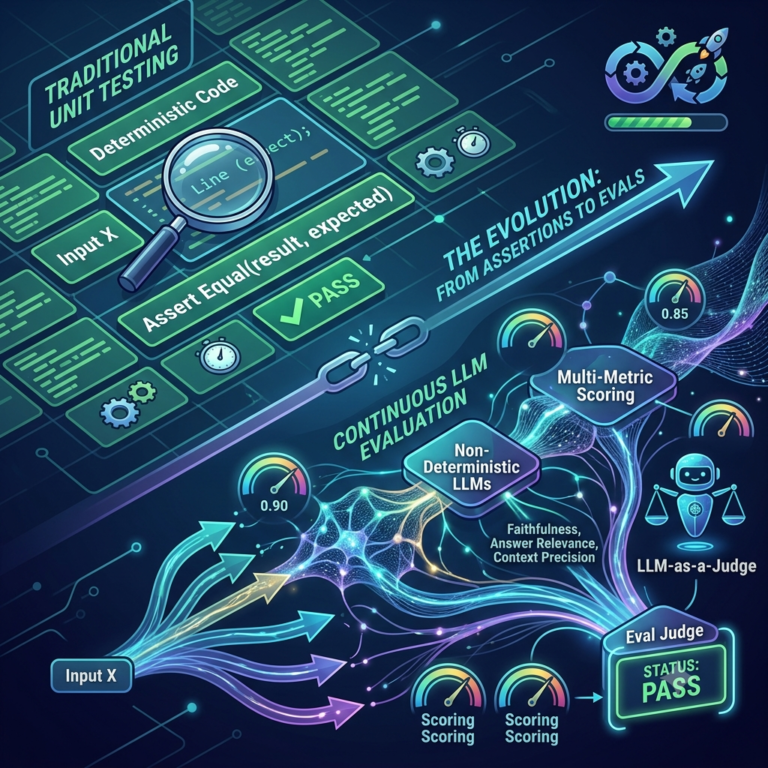
In traditional grading, a submission passes if its unit tests pass. In agentic engineering, students learn to construct comprehensive eval frameworks.
An evaluation framework measures agent performance across hundreds of trial iterations:
$$\text{Pass Rate} = \frac{\text{Successful Execution Runs}}{\text{Total Evaluation Runs}} \times 100$$
Students evaluate agents on four essential criteria:
- Task Success Rate: Did the agent resolve the assigned bug ticket?
- Tool Selection Accuracy: Did the agent invoke the minimal necessary tools, or did it make superfluous API requests?
- Token Efficiency: How many context tokens were consumed during execution?
- Safety Compliance: Did the agent adhere to sandboxing constraints?
Real-World Applications: How Technical Teams Implement Agentic AI
Organizations are actively implementing agentic software workflows across critical engineering functions.
Real-World Use Cases
Automated Legacy Code Refactoring
Updating massive legacy codebases (such as migrating Java 8 code to Java 21 or updating Python 2 syntax to Python 3) used to consume months of manual developer effort. Modern dev teams configure agentic pipelines that check out microservices, run automated dependency upgrades, refactor deprecated methods, run existing unit tests, fix breaking changes, and open pre-validated pull requests.
Continuous DevSecOps Auditing
Static application security testing (SAST) tools generate numerous false positives. Agentic security tools integrate with local repositories via MCP. When a potential vulnerability is flagged, the agent dynamically creates a test payload, verifies whether the vulnerability is actually exploitable in context, generates a minimal patch, and verifies that no regressions are introduced.
Automated Regression Triaging and CI/CD Repair
When a nightly CI/CD build fails, an agentic monitor fetches the error logs, locates the offending pull request, inspects git diffs, isolates the failing unit test, and writes a localized fix—reducing turnaround time from hours to minutes.
[External Link Suggestion: IEEE Software Engineering Standards -> https://www.ieee.org]
Traditional Development vs. Agent-Assisted vs. Agentic Software Engineering
Understanding how work shifts across these models highlights why up-skilling is critical.
| Attribute | Traditional Development | Agent-Assisted (Copilots) | Agentic Engineering (MCP) |
| Primary Developer Role | Manual code writer | Editor & prompt generator | System architect & evaluator |
| Code Execution | 100% human-driven | Human-initiated | Autonomous action loop |
| Tool Integration | Manual CLI / IDE execution | Limited IDE inline suggestions | Universal protocol (MCP) |
| Context Window | Limited by human memory | Active open file only | Full repo / database via MCP |
| Error Correction | Manual debugging | Manual re-prompting | Self-reflecting iteration loop |
| Scalability | Linear with headcount | Moderate productivity lift | Exponential task parallelization |
Future Outlook & Career Impact: Navigating the 2026+ Tech Job Market
The shift toward autonomous software workflows represents a significant evolution in developer roles. Rather than replacing software developers, AI transformation is raising the bar for entry-level competence.
CAREER EVOLUTION FOR SOFTWARE ENGINEERS
Yesterday’s Focus Tomorrow’s Focus
┌──────────────────────┐ ┌──────────────────────┐
│ • Syntax memorization│ │ • Agent orchestration│
│ • Manual debugging │ ──────────> │ • System architecture│
│ • Boilerplate code │ │ • Eval & Guardrails │
└──────────────────────┘ └──────────────────────┘
[Internal Link Suggestion: Complete Roadmap to Cloud Engineering and DevOps Success]
Up-Skilling Roadmap for Students and Professionals
To stand out in the current technical hiring market, prioritize these strategic focus areas:
- Master Systems Architecture First: Focus deeply on distributed systems, network fundamentals, data structures, and state management. AI agents generate code quickly, but human engineers must evaluate architectural validity.
- Learn MCP Tool Creation: Build custom MCP servers that bridge external APIs, internal databases, or local scripts to agent hosts.
- Study Evaluation Methodologies: Learn to write deterministic, quantitative evals using tools like Ragas, Braintrust, or custom test harnesses.
- Embrace Secure Coding and Guardrails: Develop expertise in sandbox management, authorization models, and API security to prevent agent exploit vulnerabilities.
Frequently Asked Questions (FAQ)
Will Agentic AI and MCP replace junior software developers?
No, but it fundamentally transforms what is expected of a junior engineer. Entry-level software developers are no longer evaluated purely on writing repetitive boilerplate code. Employers now look for candidates who understand core computer science principles, can read and debug AI-generated code effectively, and know how to construct reliable agent workflows and test suites.
How does MCP differ from a standard REST API?
A REST API provides static HTTP endpoints designed for predefined client calls. The Model Context Protocol (MCP) provides a dynamic, stateful communication framework specifically tailored for LLM context interaction. It allows an agent host to discover available tools, inspect resource schemas dynamically, and request execution permissions safely through a single protocol connection.
Which programming languages should I focus on for Agentic AI development?
Python and TypeScript/JavaScript remain the primary languages for agent frameworks, MCP servers, and LLM orchestration libraries. However, core system components, high-performance backends, and sandboxing infrastructure continue to rely heavily on Go, Rust, and C++.
Master the Next Era of Software Engineering
The software development world is evolving rapidly. The developers who thrive in this new landscape will not be those who resist automated tools, nor those who blindly trust raw AI outputs. Triumph belongs to technical professionals who master system design, implement robust Model Context Protocol integrations, and orchestrate agentic workflows with clarity and precision.
Start upgrading your technical toolkit today. Build your first custom MCP server, write an automated agent eval suite, and lead the future of autonomous software engineering.