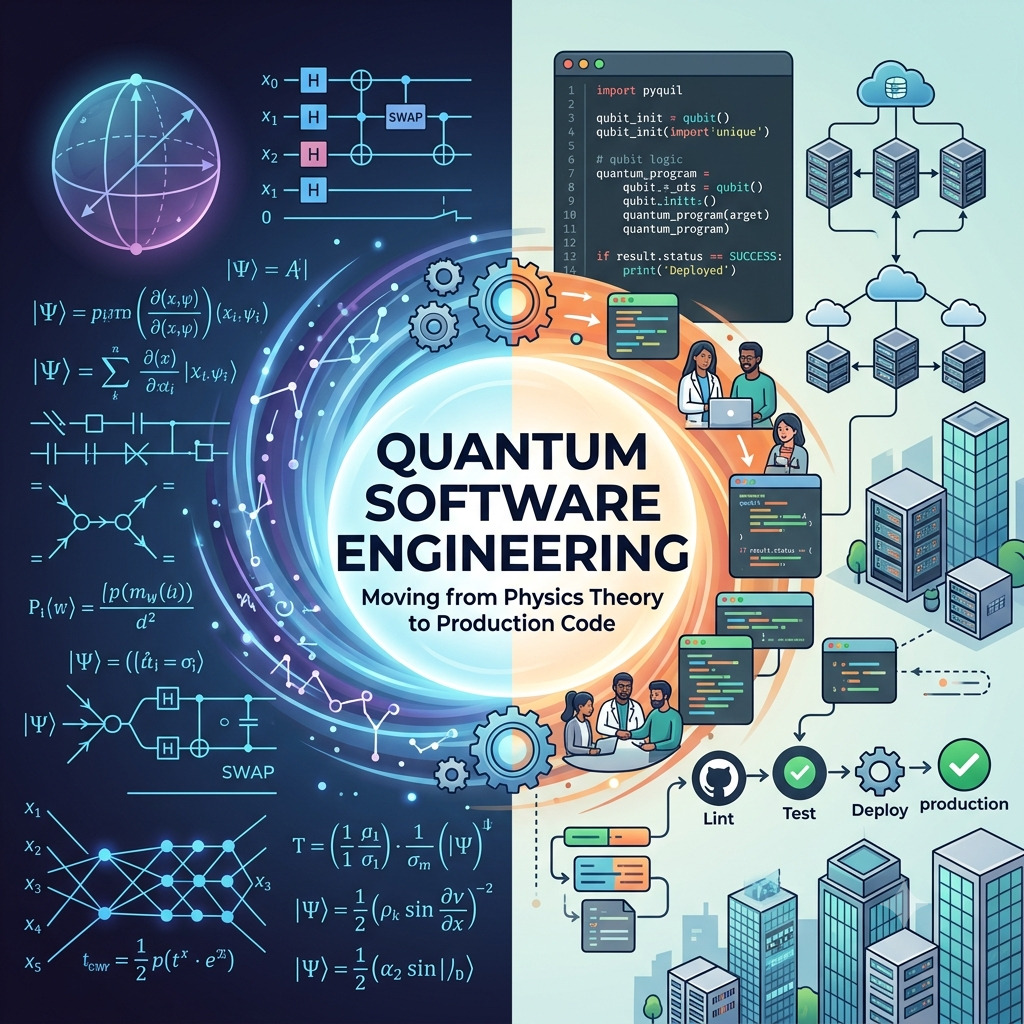
Quantum Software Engineering: Moving from Physics Theory to Production Code
For decades, quantum computing remained locked inside academic physics departments. Computer science students studied state vectors and bra-ket notation on chalkboards, while hardware engineers struggled to maintain coherence in cryogenic dilution refrigerators.
That isolation has ended. Cloud-accessible Quantum Processing Units (QPUs), noisy intermediate-scale quantum (NISQ) error mitigation frameworks, and high-level quantum software development kits (SDKs) have brought quantum programming squarely into the domain of mainstream software engineering.
Software developers no longer need a Ph.D. in theoretical physics to construct quantum circuits. By leveraging software design patterns, enterprise SDKs, and hybrid classical-quantum algorithms, development teams are building applications for molecular simulation, financial portfolio optimization, and complex logistics routing.
💡 Key Takeaways
- Software Abstraction Layers: Modern quantum development abstracts raw quantum hardware into high-level programming frameworks that run on classical cloud infrastructure.
- Core Quantum Concepts: Superposition, entanglement, and quantum interference serve as the primary computing primitives that yield exponential algorithmic speedups.
- Hybrid Execution (VQE): Practical quantum software uses hybrid architectures, passing computational subroutines between classical CPUs/GPUs and specialized QPUs.
- Post-Quantum Urgency: Preparing infrastructure for quantum computing requires implementing quantum-resistant cryptographic algorithms across data pipelines today.
Demystifying Quantum Logic Gates for Classical Programmers
To write quantum software, engineers must shift from classical bit manipulation to probabilistic linear algebra operations.
A classical bit exists in a distinct state: $0$ or $1$. A quantum bit, or qubit, exists as a linear combination of states until measured. Mathematically, a qubit state $\vert{}\psi\rangle$ is represented as:
$$\vert{}\psi\rangle = \alpha\vert{}0\rangle + \beta\vert{}1\rangle$$
Where $\alpha$ and $\beta$ are complex probability amplitudes satisfying the normalization constraint:
$$\vert{}\alpha\vert{}^2 + \vert{}\beta\vert{}^2 = 1$$
When measured, the wave function collapses: the qubit yields $0$ with probability $\vert{}\alpha\vert{}^2$ or $1$ with probability $\vert{}\beta\vert{}^2$.
THE BLOCH SPHERE REPRESENTATION
|0⟩
|
| .–.
.’ ‘.
/ | \
| o—-|—> |ψ⟩ = α|0⟩ + β|1⟩
\ /
‘. .’
`–‘
|1⟩
The Fundamental Quantum Operations
Where classical hardware applies Boolean logic gates (AND, OR, NOT), quantum hardware applies reversible unitary transformations to qubit state vectors:
- Hadamard Gate (H): Places a definite basis state ($\vert{}0\rangle$ or $\vert{}1\rangle$) into an equal superposition, making outcome probabilities equal ($50/50$).
- Pauli-X Gate (X): The quantum equivalent of a classical NOT gate; rotates a state vector by $\pi$ radians around the X-axis of the Bloch sphere.
- Controlled-NOT Gate (CNOT): A two-qubit gate that flips the target qubit’s state if and only if the control qubit is in state $\vert{}1\rangle$. This gate generates quantum entanglement.
Comparing Quantum Frameworks: Qiskit vs. Cirq vs. Q#
Selecting the right quantum software development kit depends on your target execution platform, system integration requirements, and problem domain.
[External Link Suggestion: Qiskit Open Source Framework -> https://qiskit.org]
┌────────────────────────────────────────────────────────────────────────┐
│ QUANTUM SDK ARCHITECTURE MATRIX │
│ │
│ ┌─────────────────────┐ ┌─────────────────────┐ ┌───────────┐ │
│ │ IBM Qiskit │ │ Google Cirq │ │ Microsoft │ │
│ │ (General Purpose) │ │ (NISQ Hardware Ops) │ │ Q# / QDK │ │
│ └──────────┬──────────┘ └──────────┬──────────┘ └─────┬─────┘ │
│ │ │ │ │
│ ▼ ▼ ▼ │
│ ┌─────────────────────────────────────────────────────────────────┐ │
│ │ Target QPUs & Cloud Simulators │ │
│ └─────────────────────────────────────────────────────────────────┘ │
└────────────────────────────────────────────────────────────────────────┘
1. IBM Qiskit (Python)
Qiskit is currently the most widely adopted open-source quantum development framework. It offers comprehensive modules for quantum circuit building, pulse-level hardware control, error mitigation, and domain-specific algorithm libraries (finance, chemistry, machine learning).
- Strengths: Extensive ecosystem, native cloud execution on IBM Quantum hardware, massive developer community support.
- Best For: Enterprise general-purpose quantum algorithm research and production applications.
2. Google Cirq (Python)
Cirq is tailored specifically for noisy intermediate-scale quantum (NISQ) algorithms where developers need fine-grained control over individual hardware logic gates and layout topologies.
- Strengths: Precise control over physical qubit geometry, native integration with TensorFlow Quantum.
- Best For: Low-level physical hardware optimization and hybrid quantum-classical machine learning experiments.
3. Microsoft Q# (QDK)
Q# is a domain-specific, statically typed language built specifically for quantum software development. It separates quantum algorithm descriptions from host execution drivers.
- Strengths: Strong compiler type safety, seamless integration with Azure Quantum cloud simulators.
- Best For: Large-scale structured quantum software applications and resource estimation profiling.
Hands-On Implementation: Quantum Teleportation in Qiskit
Quantum teleportation is a core protocol used to transfer a quantum state from one physical location to another using a shared entangled pair and classical communications channels.
[Internal Link Suggestion: Guide to Advanced Data Structures and System Optimization]
Here is a production-ready implementation of the Quantum Teleportation Protocol using Python and IBM Qiskit.
Python
import numpy as np
from qiskit import QuantumCircuit, QuantumRegister, ClassicalRegister, Transpile
from qiskit_aer import AerSimulator
def build_teleportation_circuit() -> QuantumCircuit:
“””Builds and returns a 3-qubit quantum teleportation circuit.
Qubit 0 (q_src): The unknown quantum state to teleport (Alice).
Qubit 1 (q_ent_a): Alice’s half of the entangled pair.
Qubit 2 (q_ent_b): Bob’s half of the entangled pair.
“””
# Initialize registers
q = QuantumRegister(3, name=”q”)
c0 = ClassicalRegister(1, name=”c0″) # Measurement of source qubit
c1 = ClassicalRegister(1, name=”c1″) # Measurement of Alice’s entangled qubit
cr_final = ClassicalRegister(1, name=”target_check”) # Bob’s final state check
qc = QuantumCircuit(q, c0, c1, cr_final)
# — Step 1: Prepare state to teleport on Qubit 0 —
# Apply rotation gates to create an arbitrary quantum state
qc.rx(np.pi / 3, q[0])
qc.barrier()
# — Step 2: Create Bell State Entanglement between Qubit 1 and Qubit 2 —
qc.h(q[1])
qc.cx(q[1], q[2])
qc.barrier()
# — Step 3: Alice performs Entangled Operations on Qubits 0 and 1 —
qc.cx(q[0], q[1])
qc.h(q[0])
qc.barrier()
# — Step 4: Alice measures her two qubits —
qc.measure(q[0], c0[0])
qc.measure(q[1], c1[0])
qc.barrier()
# — Step 5: Bob applies Conditional Corrections to Qubit 2 based on Alice’s classical bits —
# If c1 == 1, apply Pauli-X gate
qc.x(q[2]).c_if(c1, 1)
# If c0 == 1, apply Pauli-Z gate
qc.z(q[2]).c_if(c0, 1)
# Final check on Bob’s qubit
qc.measure(q[2], cr_final[0])
return qc
if __name__ == “__main__”:
print(“[QUANTUM PIPELINE] Constructing Teleportation Protocol Circuit…”)
circuit = build_teleportation_circuit()
# Initialize local Aer high-performance simulator
simulator = AerSimulator()
# Run circuit execution across 1,000 shots
compiled_circuit = transpile(circuit, simulator)
job = simulator.run(compiled_circuit, shots=1000)
result = job.result()
counts = result.get_counts()
print(f”[QUANTUM PIPELINE] Execution Complete.”)
print(f”Measurement Results Distribution: {counts}”)
Execution Breakdown
- State Preparation: We place Qubit 0 into an arbitrary superposition state using an $R_x(\pi/3)$ rotation.
- Entanglement Creation: Hadamard ($H$) and CNOT ($CX$) gates create a Bell state shared between Alice (Qubit 1) and Bob (Qubit 2).
- Measurement & Classical Signal: Alice measures her qubits, collapsing her local state and generating two classical bits.
- Conditional Reconstitution: Bob receives those two classical bits and applies conditional $X$ or $Z$ logic operations, bringing Qubit 2 into the exact state originally held by Qubit 0.
Classical vs. Quantum Development Toolchains
Understanding the shift in operational workflow helps engineers integrate quantum logic into standard software architectures.
| Framework Area | Classical Software Engineering | Quantum Software Engineering |
| Execution Primitive | Deterministic binary bits ($0, 1$) | Complex probability amplitude vectors |
| Unit Operations | NAND, NOR, AND, XOR logic gates | Unitary transformations ($H, X, Z, CNOT$) |
| Testing & Debugging | Step-by-step breakpoints, print logs | Statistical profiling, state tomographies |
| Hardware Execution | On-premise CPUs/GPUs | Cloud QPUs (Superconducting, Trapped Ion) |
| Runtime Model | Deterministic function outputs | Probabilistic sample distributions (Shots) |
| Error Management | ECC memory, parity checks | Fault-tolerant quantum error correction (QEC) |
Quantum-Resistant Cryptography and Post-Quantum Security
The rise of quantum software has introduced a critical security deadline for cybersecurity engineers and cloud administrators: Shor’s Algorithm.
Shor’s quantum algorithm solves prime factorization and discrete logarithms in polynomial time $O((\log N)^3)$, rendering asymmetric encryption protocols like RSA-2048, ECC, and Diffie-Hellman vulnerable to decryption once large-scale fault-tolerant QPUs mature.
[External Link Suggestion: NIST Post-Quantum Cryptography Standards -> https://csrc.nist.gov]
┌────────────────────────────────────────────────────────────────────────┐
│ POST-QUANTUM CRYPTOGRAPHY TRANSITION │
│ │
│ Legacy Public-Key Encryption NIST PQC Standards │
│ ┌──────────────────────────┐ ┌──────────────────────────┐ │
│ │ RSA, ECC, Diffie-Hellman │ ───────> │ ML-KEM (CRYSTALS-Kyber) │ │
│ │ (Vulnerable to Shor’s) │ │ ML-DSA (CRYSTALS-Dilithium)│ │
│ └──────────────────────────┘ └──────────────────────────┘ │
└────────────────────────────────────────────────────────────────────────┘
The Post-Quantum Migration Strategy
Organizations are implementing Crypto-Agility: updating data pipelines so cryptographic primitives can be swapped dynamically without rewriting application code.
- Inventory Cryptographic Assets: Audit application codebases, database layer encryption, TLS certificates, and API channels for legacy public-key dependencies.
- Adopt NIST PQC Standards: Implement lattice-based algorithms such as ML-KEM (Module-Lattice-Based Key-Encapsulation Mechanism) and ML-DSA for digital signatures.
- Hybrid TLS Protocols: Deploy network tunnels that combine classical ECDH key exchange alongside post-quantum key encapsulation to ensure backwards-compatible protection.
Future Outlook & Career Opportunities in the Quantum Stack
As the quantum hardware stack scales, career pathways are diversifying beyond low-level physics research into structured software roles:
QUANTUM TECH CAREER STACK
│
┌───────────────────────────────┼───────────────────────────────┐
▼ ▼ ▼
┌───────────────┐ ┌───────────────┐ ┌───────────────┐
│ Quantum Algo │ │ Hybrid Cloud │ │ Post-Quantum │
│ Developer │ │ Systems Arch │ │ Security Spec │
└───────────────┘ └───────────────┘ └───────────────┘
High-Demand Quantum Engineering Roles
- Quantum Algorithm Developer: Builds domain-specific software solutions for chemistry simulation, material discovery, and financial risk modeling using frameworks like Qiskit or Cirq.
- Hybrid Cloud Architect: Designs middleware pipelines that route incoming API workloads dynamically between classical GPU clusters and cloud QPUs.
- Post-Quantum Security Specialist: Audits legacy enterprise infrastructure, updating cryptographic libraries to lattice-based post-quantum standards.
Frequently Asked Questions (FAQ)
Do I need a Ph.D. in Physics to become a Quantum Software Engineer?
No. While hardware designers and quantum physicists benefit from doctoral degrees, modern quantum software engineering focuses on algorithm design, linear algebra, cloud architecture, and compiler engineering. Strong proficiency in computer science fundamentals and Python is sufficient to build production applications.
What is the difference between a NISQ computer and a fault-tolerant quantum computer?
NISQ (Noisy Intermediate-Scale Quantum) processors contain dozens to hundreds of physical qubits that are susceptible to environmental noise and decoherence errors. Fault-tolerant quantum computers use logical qubits built from thousands of physical error-corrected qubits, allowing them to execute deep quantum circuits reliably without state degradation.
Can quantum computers replace standard CPUs and GPUs?
No. Quantum computers act as specialized co-processors designed for specific classes of complex matrix, linear system, and combinatorial problems. Classical CPUs and GPUs remain superior for general-purpose computing tasks like web hosting, file I/O, database querying, and graphics rendering.
Conclusion & Next Steps
Quantum software engineering is transforming from an academic discipline into a commercial reality. Developers who master quantum programming SDKs, hybrid cloud design patterns, and post-quantum cryptographic standards will lead the next wave of computational infrastructure.
Your Action Plan:
- Install IBM Qiskit using pip install qiskit qiskit-aer.
- Construct and simulate a basic Bell state quantum circuit on your local machine.
- Audit your current cloud projects for legacy public-key encryption dependencies to start your post-quantum migration strategy.