From Monoliths to Agent-Friendly Architectures
- SEO Title: Agent-Friendly Codebases: How to Design Software for AI Refactoring
- Meta Description: Learn the architectural principles that make a codebase easy for autonomous AI agents to parse, refactor, and maintain.
- Target Audience: Senior Software Engineers, Computer Science Students, System Architects.
- Primary Focus: Designing software codebases specifically so AI agents can navigate, refactor, and test them easily.
Introduction: Why Spaghetti Code Paralyzes AI Agents
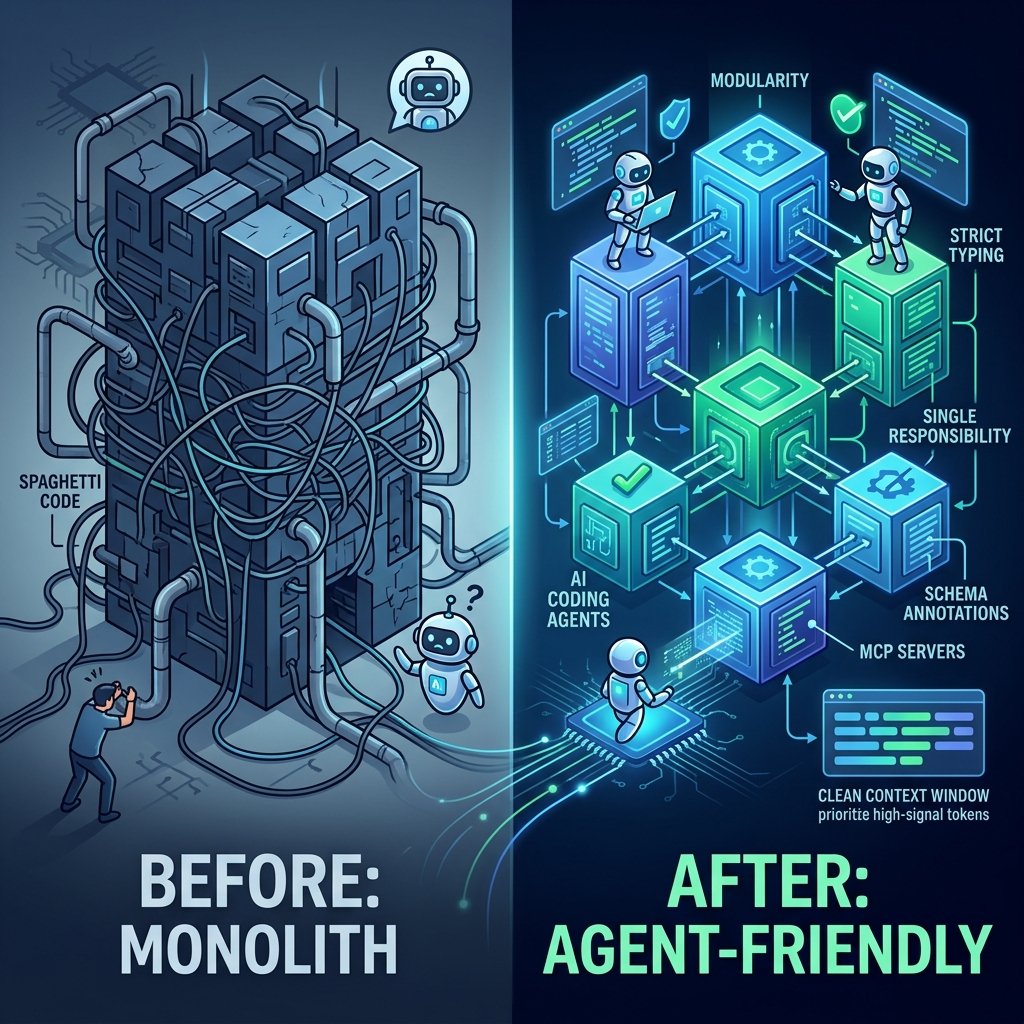
Tangled legacy architectures and “spaghetti code” have long plagued human engineering teams, leading to technical debt and slow feature velocity. In the era of autonomous coding agents, these structural flaws present a different, immediate bottleneck: context window saturation and reasoning failure.
When an AI agent attempts to refactor a function in a tightly coupled monolith, it cannot isolate the target logic. To make a single safe edit, the agent’s context pipeline must ingest thousands of lines of indirect dependencies, implicit global states, and side-effect-heavy modules. This creates two distinct failure modes:
- Context Flooding: The agent exhausts its token budget on irrelevant peripheral code, diluting its attention and increasing the likelihood of hallucinated variables or syntax errors.
- Cascading Side Effects: Because boundaries are porous, the agent makes localized changes that silently break unstated downstream assumptions, resulting in failed build cycles or runtime regressions.
Designing software for the agentic era requires treating the AI as a primary consumer of your codebase.
Pillars of Agent-Oriented Architecture
┌────────────────────────────────────────────────────────────────────────┐
│                   PILLARS OF AGENT-FRIENDLY CODE                       │
├────────────────────────────────────────────────────────────────────────┤
│                                                                        │
│  ┌──────────────────────┐        ┌──────────────────────────────────┐  │
│  │   STRICT MODULARITY  │        │    EXPLICIT TYPE DEFINITIONS     │  │
│  │ Single-responsibility│───────►│ Static typing (TypeScript/Rust/  │  │
│  │ & clear boundaries   │        │ Go) over implicit dynamic types  │  │
│  └──────────────────────┘        └────────────────┬─────────────────┘  │
│                                                   │                    │
│                                                   ▼                    │
│  ┌──────────────────────┐        ┌──────────────────────────────────┐  │
│  │ SCHEMA ANNOTATIONS   │        │     STANDARDIZED LAYOUTS         │  │
│  │ Self-describing data │◄───────┤ Predictable path conventions     │  │
│  │ interfaces & OpenAPI │        │ & deterministic module entry     │  │
│  └──────────────────────┘        └──────────────────────────────────┘  │
│                                                                        │
└────────────────────────────────────────────────────────────────────────┘
1. Strict Modularity & Single-Responsibility Boundaries
Agents excel when working within self-contained execution scopes.
- Encapsulate business logic into small, decoupled modules where each function performs a single, testable transform.
- Enforce strict boundary abstractions using dependency injection rather than reaching into global states or shared singletons.
2. Comprehensive, Explicit Type Definitions
Implicit types and dynamic dictionary structures force the agent to guess runtime shapes.
- Utilize strongly typed languages or strict type signatures (TypeScript, Rust, Go, or Python type hints with Pydantic).
- Export clear, centralized interface definitions so the agent can inspect input/output contracts using Language Server Protocol (LSP) tools without parsing whole implementation files.
3. Standardized File Structures & Explicit Schemas
Unpredictable project layouts slow down agent file-navigation loops.
- Standardize repository layouts using predictable domain-driven directories (e.g., separating
/adapters,/domain, and/ports). - Use self-describing schemas (OpenAPI, JSON Schema, Protobuf) for internal data boundaries.
Self-Documenting Code via Metadata
Beyond traditional inline comments, agentic architectures incorporate structural metadata hints designed for automated parsing:
TypeScript
/**
 * @agent-capability Calculate order fulfillment tax and discount adjustments.
 * @agent-context-files ["src/domain/tax-rates.ts", "src/types/order.ts"]
 * @agent-side-effects Read-only database query. No state mutation.
 * @agent-test-suite "tests/unit/fulfillment.test.ts"
 */
export async function calculateFulfillment(order: Order): Promise<FulfillmentSummary> {
  // Implementation...
}
By tagging functions with contextual annotations (@agent-context-files, @agent-side-effects), pre-processing tools can instantly feed the agent exact file dependencies, skipping costly repository-wide searches.
Before-and-After Code Comparison
Before: Tangled Monolithic Function (Agent-Hostile)
In this legacy Python example, data parsing, global state mutation, database writes, and notification side-effects are mixed together. An agent cannot safely unit test or modify this function without ingesting the entire application context.
Python
# UNFRIENDLY: Global state, implicit types, mixed concerns, untestable side-effects
import db_client

global_config = {}

def process_user_action(user_data):
    if user_data["type"] == "signup":
        if "email" in user_data and "@" in user_data["email"]:
            # Direct DB write with implicit dict keys
            user_id = db_client.query(f"INSERT INTO users VALUES ('{user_data['email']}')")
            # Global state side effect
            global_config["last_signup"] = user_id
            # Hardcoded external dependency
            send_email_smtp(user_data["email"], "Welcome!")
            return {"status": "ok", "id": user_id}
    return {"status": "error"}
After: Modular Component (Agent-Friendly)
Refactored for agent readability, the logic is broken into explicitly typed, pure components with injected dependencies and interface contracts.
Python
from dataclasses import dataclass
from typing import Protocol, Optional
from result import Result, Ok, Err

@dataclass(frozen=True)
class UserSignupCommand:
    email: str

@dataclass(frozen=True)
class UserAccount:
    user_id: str
    email: str

class UserRepository(Protocol):
    def save(self, command: UserSignupCommand) -> UserAccount: ...

class NotificationService(Protocol):
    def send_welcome_email(self, email: str) -> None: ...

# AGENT-FRIENDLY: Pure business logic, explicit types, zero side-effects
def create_user_account(
    command: UserSignupCommand,
    repo: UserRepository,
    notifier: NotificationService
) -> Result[UserAccount, str]:
    """Pure domain handler. Validates input and orchestrates creation."""
    if "@" not in command.email:
        return Err("Invalid email address format")

    user = repo.save(command)
    notifier.send_welcome_email(user.email)
    return Ok(user)
Frequently Asked Questions (FAQ)
Does optimizing a codebase for AI agents make it harder for humans to read?
No. Optimizing for AI agents directly reinforces clean software engineering principles.
Clear separation of concerns, explicit static typing, predictable directory structures, and decoupled dependencies make a codebase drastically easier for human engineers to onboard, maintain, and refactor. What makes a codebase “agent-friendly” is simply good architecture taken seriously.