Rust for Senior Engineers: Architecting Memory-Safe Cloud Systems
Meta Description: Discover why enterprise infrastructure is pivoting to Rust. Master the borrow checker, async pipelines with Tokio, and low-overhead memory safety.
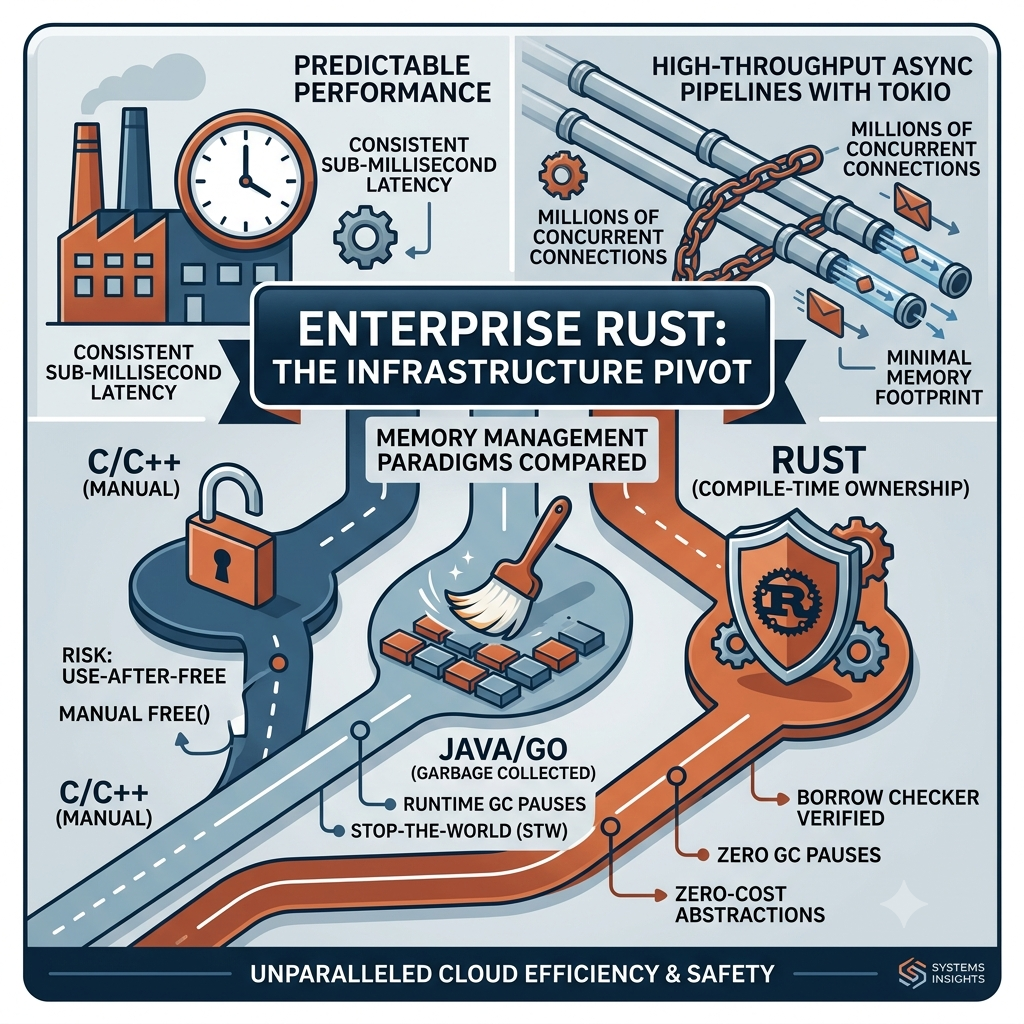
┌────────────────────────────────────────────────────────────────────────┐
│ MEMORY MANAGEMENT PARADIGMS │
│ │
│ MANUAL MEMORY MANAGEMENT GARBAGE COLLECTED │
│ (C / C++) (Java / Go / Python) │
│ ┌────────────────────────┐ ┌──────────────────────────┐ │
│ │ Developer manages malloc│ │ Background GC Pauses │ │
│ │ Risk: Use-After-Free │ │ Runtime Overhead & STW │ │
│ └────────────────────────┘ └──────────────────────────┘ │
│ │
│ RUST COMPILE-TIME OWNERSHIP │
│ ┌──────────────────────────────────────────────────────────┐ │
│ │ Borrow Checker verifies ownership rules at compile time │ │
│ │ Zero Garbage Collection | Zero Manual Memory Freeing │ │
│ └──────────────────────────────────────────────────────────┘ │
└────────────────────────────────────────────────────────────────────────┘
Software engineering at scale has encountered a structural ceiling. For decades, backend architects faced a tough compromise: select a language with a Garbage Collector (GC) like Go, Java, or C# for memory safety and developer velocity, or choose C/C++ for bare-metal performance, predictable latency, and minimal runtime footprints.
The dynamic has shifted. Historical security analysis from major technology vendors reveals that roughly 70% of all severe, enterprise-critical vulnerabilities stem directly from memory safety bugs—including use-after-free, buffer overflows, and double-free errors.
Rust has emerged as the definitive answer for low-level systems engineering. By enforcing memory safety guarantees at compile time without a garbage collector, Rust empowers senior engineers to build cloud infrastructure, databases, and microservices that deliver near-native speed with absolute safety guarantees.
💡 Key Takeaways
- Compile-Time Safety: Rust eliminates entire classes of memory safety bugs during compilation via strict ownership, borrowing, and lifetime rules.
- Zero-Cost Abstractions: Higher-level functional patterns, iterators, and generics compile down to assembly code as efficient as hand-optimized C.
- Predictable Performance: Without a runtime garbage collector to introduce Stop-The-World (STW) pauses, Rust applications maintain consistent sub-millisecond tail latencies.
- Async Scalability: Coupled with runtimes like Tokio, Rust manages millions of concurrent I/O connections with minimal memory footprint compared to virtual machine runtimes.
Why Enterprise Infrastructure Is Rewriting Critical Paths in Rust
Industry adoption of Rust has moved past experimental spikes into core infrastructure rewrite projects.
THE ENTERPRISE ADOPTION WAVE
│
┌────────────────────────────────┼────────────────────────────────┐
▼ ▼ ▼
┌────────────────────────┐ ┌────────────────────────┐ ┌────────────────────────┐
│ Linux Kernel Core │ │ Cloud Networking │ │ Database Engines │
│ Official 2nd Language │ │ AWS Bottlerocket, │ │ Vector Databases, │
│ for Memory Safety │ │ Cloudflare Edge proxy │ │ Distributed Storage │
└────────────────────────┘ └────────────────────────┘ └────────────────────────┘
The Cost of Garbage Collection at Scale
Garbage collectors simplify memory handling by routinely scanning application memory trees to reclaim unreferenced objects. While manageable at lower loads, high-throughput cloud environments encounter distinct operational challenges:
- Tail Latency Spikes ($p99$ / $p999$): GC cycles introduce unpredictable Stop-The-World pauses, degrading performance metrics.
- Resource Bloat: Managed languages require overhead memory margins—often 2x to 3x the active heap size—to prevent frequent GC cycles.
- Cloud Execution Expenses: High memory footprints translate directly to larger instance sizes and increased operational costs across serverless and Kubernetes deployments.
Rust bypasses these challenges. Memory allocation and deallocation code paths are computed deterministically by the compiler using the scope lifecycle of data objects.
Mastering Ownership, Borrowing, and Lifetimes
The core engine of Rust safety is its Ownership System, enforced entirely by the compiler’s Borrow Checker.
RUST OWNERSHIP RULES
│
┌──────────────────────────────┼──────────────────────────────┐
▼ ▼ ▼
┌──────────────────────────┐ ┌──────────────────────────┐ ┌──────────────────────────┐
│ 1. Each value has a single│ │ 2. Only one owner exists │ │ 3. Value dropped when │
│ owner variable. │ │ at a given time. │ │ owner leaves scope. │
└──────────────────────────┘ └──────────────────────────┘ └──────────────────────────┘
Borrowing Mechanics: Aliasing XOR Mutability
To prevent data races in concurrent code, Rust enforces a fundamental borrowing constraint:
You may have any number of immutable references (&T) to a resource, OR exactly one mutable reference (&mut T), but never both simultaneously.
Rust
fn main() {
let mut data = vec![1, 2, 3];
// Immutable borrows are valid concurrently
let ref1 = &data;
let ref2 = &data;
println!(“Reading references: {:?}, {:?}”, ref1, ref2);
// MUTABLE BORROW ATTEMPT:
// Un-commenting the following line causes a COMPILE ERROR because ref1/ref2 are active.
// let mut_ref = &mut data;
}
By verifying reference lifetimes at compile time, Rust guarantees that data cannot be mutated out from under another execution path, rendering data races impossible in safe Rust.
Building a High-Throughput Async Pipeline with Tokio
Async I/O in Rust relies on explicit state machines compiled directly into compact binary structures. The Tokio ecosystem serves as the foundation for asynchronous cloud systems.
[External Link Suggestion: Tokio Async Runtime Specification -> https://tokio.rs]
Here is a resilient event processing pipeline that ingests data concurrently, processes tasks in parallel worker pools, and writes results back safely:
Rust
use std::sync::Arc;
use tokio::sync::{mpsc, Mutex};
use tokio::time::{sleep, Duration};
#[derive(Debug, Clone)]
struct CloudEvent {
id: u64,
payload: String,
}
#[derive(Debug)]
struct AuditLog {
processed_count: u64,
}
#[tokio::main]
async fn main() -> Result<(), Box<dyn std::error::Error>> {
println!(“[SYSTEM STARTUP] Initializing Async Cloud Engine…”);
// Create a multi-producer, single-consumer bounded channel
let (tx, mut rx) = mpsc::channel::<CloudEvent>(100);
// Thread-safe shared audit state wrapped in Atomic Reference Counter (Arc) & Mutex
let audit_log = Arc::new(Mutex::new(AuditLog { processed_count: 0 }));
// Spawn 3 concurrent Worker Tasks
for worker_id in 1..=3 {
let producer_clone = tx.clone();
tokio::spawn(async move {
for i in 1..=5 {
let event = CloudEvent {
id: (worker_id * 10) + i,
payload: format!(“Data payload from Worker {}”, worker_id),
};
// Asynchronous channel dispatch
if let Err(e) = producer_clone.send(event).await {
eprintln!(“[WORKER ERROR] Channel closed: {}”, e);
break;
}
sleep(Duration::from_millis(150)).await;
}
});
}
// Drop original sender reference so channel closes cleanly when workers complete
drop(tx);
// Process incoming stream asynchronously
while let Some(event) = rx.recv().await {
let log_ref = Arc::clone(&audit_log);
// Process each event in a lightweight execution thread
tokio::spawn(async move {
// Business logic execution space
println!(“[PROCESSING] Event ID: {} -> Content: {}”, event.id, event.payload);
// Thread-safe state update
let mut guard = log_ref.lock().await;
guard.processed_count += 1;
});
}
// Allow background handlers to finalize processing
sleep(Duration::from_millis(500)).await;
let final_stats = audit_log.lock().await;
println!(“[SYSTEM COMPLETE] Total Telemetry Events Processed: {}”, final_stats.processed_count);
Ok(())
}
Key Architectural Highlights
- Zero Memory Leaks: Channel allocations and event scopes drop out of memory automatically as processing tasks finish.
- Concurrency Safety: The compiler enforces Arc (Atomic Reference Counting) to share data across tasks and Mutex to guard mutable access. Attempting to pass an unsafe non-thread-safe reference across asynchronous boundaries triggers a clear compile-time error.
Comparing Infrastructure Languages: C++ vs. Go vs. Rust
Choosing the right systems programming language requires balancing memory models, operational control, and runtime footprints:
| Architectural Feature | C++20 / C++23 | Go 1.2x | Rust 2024 Edition |
| Memory Safety | Manual / Weak (Pointers) | Safe (Managed GC) | Compile-Time Guaranteed |
| Garbage Collector | None | Yes (Concurrent GC) | None |
| Concurrency Model | Pthreads / Native Threads | Goroutines (CSP) | Async / Await (Tokio/Mio) |
| Runtime Size Overhead | Minimal (< 1 MB) | Built-In Runtime (~2–5 MB) | Minimal (< 1 MB) |
| Data Race Safety | Manual Developer Audits | Dynamic Race Detector | Compile-Time Enforced |
| Generics Implementation | Templates (Monomorphized) | Interface Boxing / Monomorph | Traits (Zero-Cost) |
Real-World Case Study: Cloud-Native Upgrades
[Internal Link Suggestion: Modern Microservices and Distributed System Design]
Cloudflare Pingora Framework
Cloudflare replaced their legacy NGINX infrastructure with Pingora, a custom async Rust framework.
- Results: Pingora handles hundreds of billions of requests daily while using 70% less CPU and 67% less memory than their prior NGINX setup, while completely removing memory-safety crash vulnerabilities.
Amazon Web Services (AWS)
AWS relies on Rust for core cloud hypervisors and storage software, including Firecracker (the microVM engine powering AWS Lambda) and Bottlerocket (a security-focused Linux distribution for containers).
Strategic Skill Roadmap for Systems Developers
To transition successfully to enterprise Rust development, focus on these foundational subject areas:
RUST MASTERY PROGRESSION
│
┌──────────────────────────────┼──────────────────────────────┐
▼ ▼ ▼
┌──────────────────────────┐ ┌──────────────────────────┐ ┌──────────────────────────┐
│ Phase 1: Core Mechanics │ │ Phase 2: Async Systems │ │ Phase 3: Infrastructure │
│ Borrow Checker, Traits, │ │ Tokio, Pinning, Futures, │ │ FFI, Zero-Copy I/O, │
│ Lifetimes, Smart Pointers│ │ MPSC Channels, Streams │ │ SIMD, Unsafe Auditing │
└──────────────────────────┘ └──────────────────────────┘ └──────────────────────────┘
- Internalize Lifetime Semantics: Understand how the Rust compiler tracks variable scopes to write clean function signatures without over-cloning data structures.
- Master Trait-Based Design: Replace traditional Object-Oriented polymorphism with composition patterns using Rust Traits and Associated Types.
- Practice Defensive Error Handling: Leverage Result<T, E> and Option<T> primitives alongside the ? operator to write robust error propagation routines without throwing uncaught runtime exceptions.
Frequently Asked Questions (FAQ)
Is Rust difficult to learn compared to Go or Python?
Rust presents a steeper initial learning curve due to compile-time ownership rules, borrowing constraints, and explicit lifetime annotations. However, once developers master these concepts, the compiler guides development by catching edge-case errors before code reaches production environments.
When should an organization choose Go over Rust?
Go remains an ideal choice for general microservices, enterprise CRUD APIs, and CLI utilities where development speed and team onboarding velocity outweigh low-level memory efficiency or microsecond tail-latency requirements.
What is the purpose of unsafe code in Rust?
The unsafe keyword disables specific compiler checks to allow low-level operations like direct pointer dereferencing, interfacing with hardware devices, or calling foreign C APIs (FFI). It does not deactivate all security checks, and production codebases isolate unsafe code inside tightly audited abstractions.
Conclusion & Action Steps
Rust has transformed from an experimental alternative into an enterprise standard for high-performance, memory-safe cloud infrastructure. By replacing manual pointer handling and garbage collection overhead with compile-time ownership checks, Rust enables teams to build resilient, cost-effective systems.
Next Steps for Your Engineering Team:
- Install Rust via rustup and complete the core exercises in The Rust Programming Language.
- Refactor an internal, CPU-heavy backend utility into Rust using the tokio runtime.
- Establish static code analysis benchmarks using cargo clippy and memory profiling using miri.