Real-Time Data Streaming Architecture: Apache Kafka, Flink, and Event-Driven Design
Meta Description: Learn real-time data streaming architectures. Explore event-driven design, Apache Kafka log storage, Apache Flink stateful stream processing, and event sourcing.
┌────────────────────────────────────────────────────────────────────────┐
│ BATCH PROCESSING VS. STREAMING │
│ │
│ TRADITIONAL BATCH PROCESSING (High Latency) │
│ ┌──────────────┐ Scheduled ETL ┌───────────────┐ │
│ │ Data Storage ├──────────────────────>│ Data Warehouse│ │
│ │ (Database) │ (Hourly / Daily) │ (Analytics) │ │
│ └──────────────┘ └───────────────┘ │
│ │
│ EVENT-DRIVEN STREAM PROCESSING (Low Latency) │
│ ┌──────────────┐ Continuous Events ┌───────────────┐ │
│ │ Event Producer├─────────────────────>│ Distributed │ │
│ └──────────────┘ │ Event Log │ │
│ │ (Kafka) │ │
│ └───────┬───────┘ │
│ │ Stream Computations │
│ ▼ │
│ ┌───────────────┐ │
│ │ Stateful Engine│ │
│ │ (Apache Flink)│ │
│ └───────────────┘ │
└────────────────────────────────────────────────────────────────────────┘
Historically, enterprise data architectures relied heavily on batch processing. Systems accumulated transactions throughout the day inside relational databases, extracted them via nightly ETL (Extract, Transform, Load) jobs, and loaded them into data warehouses for analysis.
While batch processing works for static daily reporting, modern digital businesses require immediate feedback. Financial fraud detection, dynamic pricing models, supply chain tracking, and real-time recommendation engines require continuous processing of incoming data streams as events happen.
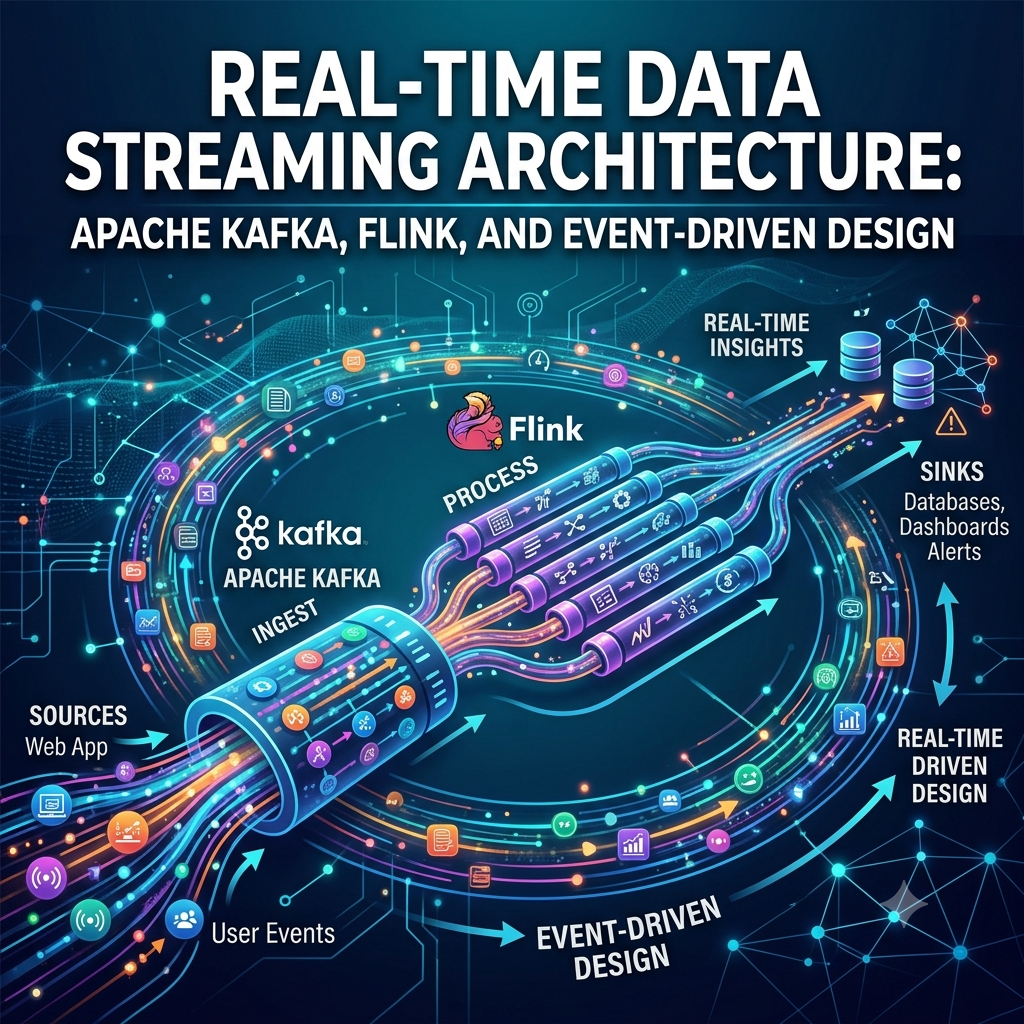
Real-Time Data Streaming Architecture replaces scheduled batch processing with continuous event processing. By combining high-throughput distributed message logs (Apache Kafka) with stateful stream processing engines (Apache Flink), software engineers can build event-driven systems that process millions of records per second with millisecond latencies.
💡 Key Takeaways
- Event-Driven Paradigms: Systems react immediately to continuous immutable event streams rather than running periodic database queries.
- Append-Only Distributed Logs: Apache Kafka stores events as partitioned, immutable append-only logs, enabling high write throughput and replayability.
- Stateful Stream Processing: Apache Flink handles stateful computations (such as tumbling and sliding time windows) with exactly-once processing guarantees.
- Out-of-Order Data Handling: Event-Time processing combined with Watermarks allows streaming applications to process late or out-of-order data accurately.
The Core Primitives of Event-Driven Architecture
In an event-driven system, state changes are captured as events—immutable statements of fact recording something that occurred in the business domain.
┌────────────────────────────────────────────────────────────────────────┐
│ EVENT-DRIVEN SYSTEM PATTERNS │
│ │
│ 1. Event Notification : Lightweight signal that a state changed │
│ 2. Event-Carried State: Payload contains full state update data │
│ 3. Event Sourcing : Domain state is rebuilt by replaying events │
│ 4. CQRS : Command and Query responsibilities split │
└────────────────────────────────────────────────────────────────────────┘
Event Sourcing vs. Traditional Database Mutation
In a traditional relational database, executing an UPDATE query overwrites existing record states, losing historical context.
Event Sourcing stores every domain change as a sequential sequence of append-only events. The current system state is calculated by replaying those historical events from the beginning of the stream log:
$$\text{Current State} = \sum_{t=0}^{T} \text{Event}_t$$
This approach provides a complete audit trail, simplifies time-travel debugging, and allows new analytical microservices to consume historical event logs independently.
Inside Apache Kafka: The Distributed Log Architecture
Apache Kafka acts as the central messaging backbone for real-time streaming architectures. Unlike traditional message queues that delete messages once consumed, Kafka functions as a distributed, persistent Append-Only Log.
┌────────────────────────────────────────────────────────────────────────┐
│ KAFKA TOPIC PARTITION LOG │
│ │
│ TOPIC: “payment-events” (Partition 0) │
│ ┌─────────┬─────────┬─────────┬─────────┬─────────┬─────────┐ │
│ │Offset 0 │Offset 1 │Offset 2 │Offset 3 │Offset 4 │Offset 5 │ … │
│ │Event A │Event B │Event C │Event D │Event E │Event F │ │
│ └─────────┴─────────┴─────────┴─────────┴─────────┴─────────┘ │
│ ▲ │
│ │ Consumer Offset Position│
│ ┌─────────┴─────────┐ │
│ │ Analytics Service │ │
│ └───────────────────┘ │
└────────────────────────────────────────────────────────────────────────┘
Key Kafka Concepts
- Topics & Partitions: Topics are categorized event streams. Topics are divided into Partitions distributed across cluster brokers to enable parallel processing and horizontal scaling.
- Offsets: Each event within a partition is assigned an incremental, immutable integer index called an Offset. Consumers track their offset position independently to read messages at their own pace.
- Producers & Consumer Groups: Producers publish events using partition key hashes. Consumer Groups load-balance partition processing across multiple service instances automatically.
Stateful Processing with Apache Flink: Windows & Watermarks
While Kafka stores and transports event streams, Apache Flink executes complex continuous computations over those streams in memory.
Handling Time in Streaming Systems
Real-world network connections introduce variable latencies, causing events to arrive out of order. Flink distinguishes between three types of time:
- Event Time: The exact moment the event occurred on the source device (embedded in the event payload timestamp).
- Ingestion Time: The timestamp when the event entered the streaming pipeline.
- Processing Time: The local clock time of the cluster node processing the event.
To process out-of-order data accurately using Event Time, Flink uses Watermarks.
┌────────────────────────────────────────────────────────────────────────┐
│ WATERMARKS & EVENT-TIME PROCESSING │
│ │
│ Stream Flow : [e(t=12)] ──> [e(t=10)] ──> [Watermark(t=8)] ──> │
│ │ │
│ Meaning : “No more events with timestamp t < 8 will arrive.” │
│ Action : Triggers time-window computation safely. │
└────────────────────────────────────────────────────────────────────────┘
A Watermark is a control element embedded into the data stream that signals time progression. A Watermark of $t = 8$ informs the engine that it should assume all incoming events with timestamps $t \le 8$ have already been observed, allowing Flink to trigger time-window calculations safely.
Hands-On Implementation: Real-Time Fraud Detection with PyFlink
Let’s implement a real-time fraud detection pipeline using PyFlink (Apache Flink’s Python API). The job continuously monitors a stream of transaction events, evaluates a sliding 1-minute window per account, and flags accounts issuing more than 3 transactions within that window.
Python
from pyflink.datastream import StreamExecutionEnvironment
from pyflink.datastream.window import SlidingEventTimeWindows
from pyflink.common.time import Time
from pyflink.common.watermark_strategy import WatermarkStrategy
from pyflink.common.typeinfo import Types
from pyflink.datastream.functions import ProcessWindowFunction
import json
class FraudDetectionWindowFunction(ProcessWindowFunction):
“””
Evaluates transaction counts within a sliding window to detect fraud anomalies.
“””
def process(self, key, context, elements):
transaction_count = len(list(elements))
# Flag potential fraud if transaction volume exceeds threshold within window
if transaction_count >= 3:
yield json.dumps({
“account_id”: key,
“window_end”: context.window().end,
“transaction_count”: transaction_count,
“alert”: “CRITICAL_HIGH_TRANSACTION_FREQUENCY”
})
def run_fraud_detection_pipeline():
print(“[INIT] Starting Flink Real-Time Streaming Environment…”)
env = StreamExecutionEnvironment.get_execution_environment()
env.set_parallelism(1)
# Synthetic Input Stream representing incoming payment transactions
raw_transactions = [
json.dumps({“account_id”: “ACC-101”, “amount”: 150.0, “timestamp”: 1000}),
json.dumps({“account_id”: “ACC-101”, “amount”: 200.0, “timestamp”: 1500}),
json.dumps({“account_id”: “ACC-102”, “amount”: 50.0, “timestamp”: 2000}),
json.dumps({“account_id”: “ACC-101”, “amount”: 300.0, “timestamp”: 2500}), # 3rd tx for ACC-101
]
# Create DataStream from in-memory collection
ds = env.from_collection(raw_transactions)
# Configure Event-Time Watermarking strategy (allowing 2 seconds of out-of-order bounded lateness)
watermark_strategy = WatermarkStrategy.for_bounded_out_of_orderness(
Time.seconds(2)
).with_timestamp_assigner(lambda event, _: json.loads(event)[“timestamp”])
# Stream Processing Pipeline Transformation
processed_stream = (
ds.assign_timestamps_and_watermarks(watermark_strategy)
.map(lambda x: (json.loads(x)[“account_id”], x), output_type=Types.TUPLE([Types.STRING(), Types.STRING()]))
.key_by(lambda tuple_elem: tuple_elem[0]) # Key stream by Account ID
.window(SlidingEventTimeWindows.of(Time.seconds(60), Time.seconds(5))) # 60s Window, 5s Slide
.process(FraudDetectionWindowFunction(), output_type=Types.STRING())
)
print(“\n— STREAMING OUTPUT RESULTS —“)
processed_stream.print()
env.execute(“Real-Time Fraud Detection Job”)
if __name__ == “__main__”:
run_fraud_detection_pipeline()
Comparing Stream Processing Engines
Architects select stream processing engines based on throughput, latency, and state complexity needs:
| Engine / Framework | Processing Model | Latency | State Management | Primary Use Case |
| Apache Flink | True Continuous Streaming | Low ($<10\text{ms}$) | Managed State RocksDB / Chandy-Lamport | Complex event-time stateful analytics |
| Apache Kafka Streams | Native Client Library | Low ($<10\text{ms}$) | Embedded RocksDB | Lightweight microservice stream apps |
| Spark Streaming | Structured Micro-Batching | Medium ($100\text{ms}+$) | In-memory Checkpointing | Unified batch & analytics pipelines |
Frequently Asked Questions (FAQ)
How does Apache Flink achieve Exactly-Once Processing guarantees?
Flink achieves exactly-once state consistency using a variant of the Chandy-Lamport Algorithm called Asynchronous Barrier Snapshotting (ABS). Flink periodically injects checkpoint barriers into the data stream. When operators receive these barriers, they snapshot their internal state to durable storage (like HDFS or S3) without stopping stream execution.
What is the difference between a Tumbling Window and a Sliding Window?
- Tumbling Window: Fixed-size, non-overlapping time windows (e.g., every 5 minutes). Each event belongs to exactly one window instance.
- Sliding Window: Fixed-size, overlapping time windows (e.g., a 10-minute window that slides every 1 minute). Events can belong to multiple overlapping windows simultaneously.
Why use Apache Kafka over traditional message brokers like RabbitMQ?
Traditional message queues like RabbitMQ prioritize transient message routing and delete messages as soon as consumers acknowledge them. Kafka acts as an append-only distributed storage engine that retains messages on disk according to configurable retention policies. This design allows multiple consumers to read, process, and replay historical event streams independently.
Conclusion & Action Steps
Real-time data streaming architectures allow organizations to process information immediately as events occur. By leveraging Apache Kafka for durable message logs and Apache Flink for stateful event-time transformations, data engineering teams can build scalable, low-latency data pipelines.
Next Steps for Data Engineers:
- Set up a local single-node Kafka cluster using Docker Compose.
- Design event payload schemas using Apache Avro or Protocol Buffers paired with a Schema Registry to enforce schema evolution standards.
- Build a prototype Flink job using Sliding Windows to process streaming log data locally.