Edge Computing and Local-First Architecture: Designing Resilient Offline Web Apps
Meta Description: Master local-first architecture and edge computing. Learn CRDT data synchronization, offline-first PWA design, and state management at the cloud edge.
┌────────────────────────────────────────────────────────────────────────┐
│ CLOUD-CENTRIC VS. LOCAL-FIRST │
│ │
│ TRADITIONAL CLOUD-CENTRIC ARCHITECTURE │
│ ┌──────────────────────┐ Network Request ┌──────────────────┐ │
│ │ Client UI ├──────────────────────>│ Cloud Database │ │
│ │ (Blocked / Waiting) │<──────────────────────┤ (Source of Truth)│ │
│ └──────────────────────┘ High Latency / IO └──────────────────┘ │
│ │
│ LOCAL-FIRST ARCHITECTURE (ZERO LATENCY) │
│ ┌─────────────────────────────────────────────┐ Background Sync │
│ │ Client UI <──Instant Read/Write──> Local DB│ (CRDT / P2P) │
│ └──────────────────────────────────────┬──────┘ ┌────────────────┐ │
│ └────────>│ Cloud / Edge │ │
│ │ Backup Node │ │
│ └────────────────┘ │
└────────────────────────────────────────────────────────────────────────┘
The standard web development paradigm is experiencing a fundamental shift. For over two decades, applications operated on a cloud-centric client-server model: the browser acted as a thin display client, sending HTTP requests across the network to a centralized database server holding the single source of truth.
While this model powered the SaaS boom, it introduced significant user experience drawbacks: network latency, mandatory connectivity, spinner-heavy UIs, and data lock-in. If a user enters a tunnel, boards an airplane, or experiences cloud provider outages, their application stops functioning.
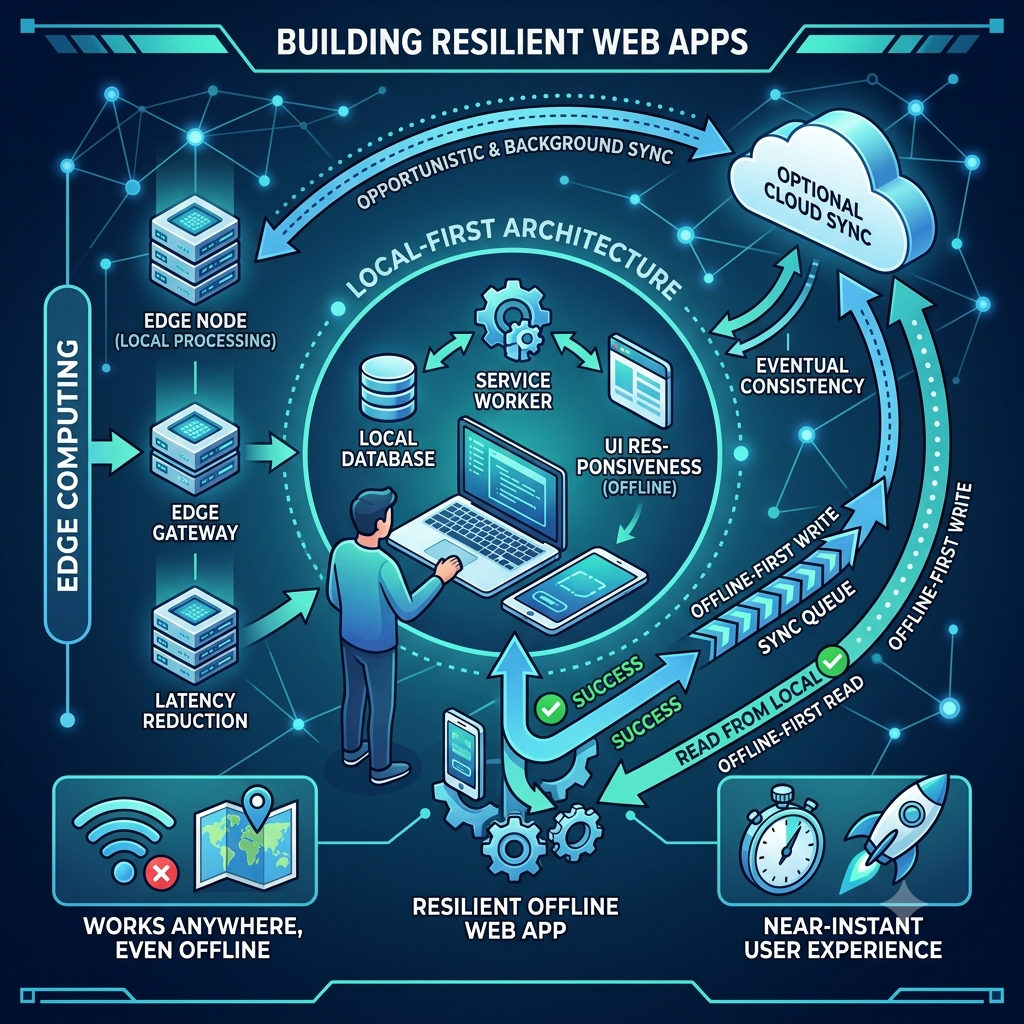
Local-First Architecture turns this paradigm inside out. By combining local, embedded databases (like IndexedDB or SQLite) on user devices with background Conflict-Free Replicated Data Type (CRDT) synchronization engines, local-first applications offer instant offline reads/writes, zero-latency user interfaces, and seamless multi-device state synchronization.
💡 Key Takeaways
- Local Data Ownership: In local-first software, the primary source of truth lives locally on the user’s client device, not on a remote cloud server.
- Zero-Latency UI: Local reads and writes happen in milliseconds directly against embedded client databases, bypassing network wait times entirely.
- Conflict-Free Synchronization: CRDTs mathematically merge concurrent, offline edits from multiple devices without requiring complex manual conflict resolution logic.
- Edge Workers as Sync Coordinators: Distributed edge networks (e.g., Cloudflare Workers) act as low-latency sync brokers and durability backups rather than primary bottleneck servers.
The Limits of Cloud-Centric Web Applications
Modern software users expect fast, fluid digital experiences. However, traditional cloud architectures introduce structural bottlenecks that degrade application performance:
┌────────────────────────────────────────────────────────────────────────┐
│ THE CLOUD NETWORK LATENCY GAP │
│ │
│ Local CPU / RAM Memory Access : ~1 – 10 Nanoseconds │
│ Local SSD / SQLite Database : ~0.1 – 1 Millisecond │
│ Cloud Edge Function Execution : ~10 – 50 Milliseconds │
│ Cross-Country Cloud Database : ~100 – 350+ Milliseconds │
└────────────────────────────────────────────────────────────────────────┘
When an application relies on cloud round-trips for every UI state update:
- Network Reliability Risk: Weak mobile connections or server hiccups lead to failed operations, dropped form states, and broken user workflows.
- High Latency: Waiting hundreds of milliseconds for simple task additions or text edits makes web applications feel sluggish compared to desktop software.
- Data Sovereignty Constraints: Users do not truly own their data; if a SaaS vendor goes offline or terminates an account, the user loses access to their data history.
Understanding CRDTs: Conflict-Free Replicated Data Types
The primary technical challenge of local-first software is state convergence. If User A edits a document offline while User B edits the exact same document on another device, how do those changes reconcile when both reconnect to the network?
Traditional approaches rely on operational transformation (OT) or coarse “last-write-wins” timestamps, which often result in lost data or complex merge conflicts. Local-first software solves this using Conflict-Free Replicated Data Types (CRDTs).
┌────────────────────────────────────────────────────────────────────────┐
│ CRDT STATE CONVERGENCE │
│ │
│ User A (Offline Node) User B (Offline Node) │
│ ┌────────────────────────┐ ┌────────────────────────┐ │
│ │ State: [A, B] │ │ State: [A, B] │ │
│ │ Edit: Insert ‘C’ at k=2│ │ Edit: Insert ‘D’ at k=2│ │
│ └───────────┬────────────┘ └───────────┬────────────┘ │
│ │ │ │
│ └──────────────────┬───────────────────┘ │
│ ▼ │
│ Deterministic Merge Algorithm │
│ Result on Both Devices: [A, B, C, D] │
└────────────────────────────────────────────────────────────────────────┘
How CRDTs Guarantee Mathematical Convergence
A CRDT is a specialized data structure designed to be replicated across multiple network nodes. CRDTs satisfy three key mathematical properties:
- Commutative: The order in which concurrent edits are received does not change the final state: $A \star B = B \star A$.
- Associative: How operation batches are grouped does not alter the outcome: $(A \star B) \star C = A \star (B \star C)$.
- Idempotent: Applying the same operation multiple times yields the exact same result: $A \star A = A$.
Because of these properties, nodes can exchange edit operations asynchronously in any order. Once all operations are received, every client device mathematically converges to the exact same state automatically.
Hands-On Implementation: Building an Offline-First Sync Engine in TypeScript
Let’s build a functional, local-first state synchronizer using TypeScript and the State-based CRDT pattern (specifically, a PN-Counter that supports incrementing and decrementing values independently across offline clients).
TypeScript
interface VectorClock {
[clientId: string]: number;
}
export class PNCounterCRDT {
public readonly clientId: string;
private P: VectorClock = {}; // Positive increment tracking
private N: VectorClock = {}; // Negative decrement tracking
constructor(clientId: string) {
this.clientId = clientId;
this.P[this.clientId] = 0;
this.N[this.clientId] = 0;
}
/** Read current converged state locally (Zero Latency) */
public value(): number {
const sumP = Object.values(this.P).reduce((acc, val) => acc + val, 0);
const sumN = Object.values(this.N).reduce((acc, val) => acc + val, 0);
return sumP – sumN;
}
/** Local Mutation: Increment counter */
public increment(amount: number = 1): void {
this.P[this.clientId] = (this.P[this.clientId] || 0) + amount;
}
/** Local Mutation: Decrement counter */
public decrement(amount: number = 1): void {
this.N[this.clientId] = (this.N[this.clientId] || 0) + amount;
}
/** Merge state payload received from remote node across the network */
public merge(remoteState: { P: VectorClock; N: VectorClock }): void {
// Merge positive vector map using maximum values per client
for (const id in remoteState.P) {
this.P[id] = Math.max(this.P[id] || 0, remoteState.P[id]);
}
// Merge negative vector map using maximum values per client
for (const id in remoteState.N) {
this.N[id] = Math.max(this.N[id] || 0, remoteState.N[id]);
}
}
/** Export payload for network distribution */
public getState() {
return { P: { …this.P }, N: { …this.N } };
}
}
// — EXECUTION DEMONSTRATION —
console.log(“[LOCAL-FIRST] Initializing offline client nodes…”);
const nodeAlice = new PNCounterCRDT(“Alice-Device”);
const nodeBob = new PNCounterCRDT(“Bob-Device”);
// Both clients perform mutations offline independently
nodeAlice.increment(5);
nodeBob.increment(10);
nodeBob.decrement(2);
console.log(`Alice Local Value (Offline): ${nodeAlice.value()}`); // Output: 5
console.log(`Bob Local Value (Offline) : ${nodeBob.value()}`); // Output: 8
// Clients connect and exchange state representations
console.log(“\n[NETWORK CONNECTED] Exchanging CRDT state sync payloads…”);
nodeAlice.merge(nodeBob.getState());
nodeBob.merge(nodeAlice.getState());
console.log(`Alice Converged Value: ${nodeAlice.value()}`); // Output: 13
console.log(`Bob Converged Value : ${nodeBob.value()}`); // Output: 13
Architectural Comparison: Cloud-Centric vs. Local-First Paradigms
| Architectural Metric | Traditional Cloud-Centric | Local-First Architecture |
| Primary Data Store | Remote Cloud Database | Embedded Client Store (IndexedDB/SQLite) |
| Offline Capability | Non-existent or read-only caching | Full read and write functionality |
| User Interaction Latency | Network-dependent ($100\text{ms} – 2000\text{ms}$) | Instantaneous ($0\text{ms} – 2\text{ms}$) |
| Conflict Resolution | Server-side lock or “Last Write Wins” | CRDT Mathematical Auto-Merge |
| Cloud Server Role | Primary compute and storage bottleneck | Low-latency sync relay & backup store |
| User Privacy & Ownership | Vendor holds user data | User holds encrypted primary data |
The Role of Edge Computing in Local-First Frameworks
Local-first architecture does not eliminate the cloud—it refines its role.
Instead of hosting monolithic backend application servers, cloud infrastructure moves to Edge Computing Networks (such as Cloudflare Workers, Fastly Compute@Edge, or AWS Lambda@Edge).
┌────────────────────────────────────────────────────────────────────────┐
│ EDGE NETWORKS AS SYNC COORDINATORS │
│ │
│ Client Device A (Client-DB) ──┐ │
│ │ Sub-Millisecond Sync Stream │
│ Client Device B (Client-DB) ──┼──> [ Edge Compute Node / Durable ] │
│ │ • Verifies Auth Tokens │
│ Client Device C (Client-DB) ──┘ • Relays CRDT Diff Payloads │
│ • Backs up Encrypted Blobs │
└────────────────────────────────────────────────────────────────────────┘
How Edge Runtimes Empower Local-First Systems
- Low-Latency Relay: Edge worker nodes sit physically close to users globally, serving as ultra-fast WebSocket relays to pass CRDT diff payloads between connected client devices.
- Encrypted Blob Backup: Edge runtimes store encrypted state snapshots, ensuring users can restore application histories if local hardware is lost or damaged.
- Authentication & Access Gates: Edge functions validate user access tokens and authorize state sync requests before broadcasting updates across client clusters.
Ecosystem Toolkit for Local-First Developers
Engineers looking to build local-first web applications can leverage these production-ready frameworks:
- Yjs: A modular, high-performance CRDT framework designed for shared collaborative editing across rich-text editors and state trees.
- Automerge: A feature-complete JSON-like CRDT library written in Rust with JavaScript bindings, optimized for complex nested document structures.
- ElectricSQL: A synchronization layer that mirrors PostgreSQL database subsets into local, client-side SQLite databases inside the browser.
- RxDB: A reactive, offline-first JavaScript database that syncs data seamlessly with remote backends like CouchDB, GraphQL, or Firebase.
Frequently Asked Questions (FAQ)
What happens to local-first app data if a user clears their browser cache?
If an application stores data exclusively inside unpersisted browser caches, clearing site data wipes local updates. Local-first applications prevent this by requesting persistent storage access via the Web Storage API (navigator.storage.persist()) and syncing encrypted backup snapshots to cloud edge storage continuously when online.
Are local-first architectures suitable for high-security applications?
Yes. Local-first designs enhance data privacy by keeping sensitive information local to user devices. End-to-End Encryption (E2EE) can be applied directly on client devices before state updates sync through cloud edge servers, ensuring hosting providers cannot view unencrypted application data.
How do local-first apps manage large datasets that exceed browser storage limits?
Modern browser engines allocate up to 80%+ of available local disk space to IndexedDB instances, providing tens or hundreds of gigabytes of storage capacity. For exceptionally large enterprise datasets, local-first engines implement partial replication, syncing active working subsets locally while querying archive data from cloud storage on demand.
Conclusion & Action Steps
Local-first architecture combines the responsiveness of native desktop software with the collaborative power of cloud computing. By shifting primary data storage to user devices and coordinating updates via CRDTs and edge networks, engineers can build resilient, zero-latency web applications that work reliably anywhere.
Next Steps for Web Architects:
- Test your current web application’s offline resilience using Chrome DevTools network throttling.
- Build a local state prototype using Yjs or Automerge to explore CRDT data synchronization.
- Replace direct cloud API fetch patterns with local storage reads using IndexedDB or SQLite via WebAssembly.